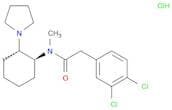
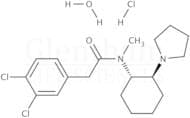
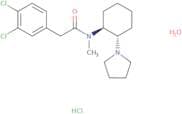
![Benzeneacetamide,3,4-dichloro-N-methyl-N-[(1S,2S)-2-(1-pyrrolidinyl)cyclohexyl]-, hydrochloride(1:…](/_next/image/?url=https%3A%2Fstatic.cymitquimica.com%2Fcas-image%2Fthumb-webp%2F2687-benzeneacetamide-34-dichloro-n-methyl-n-1s-2s-2-1-pyrrolidinyl-cyclohexyl-hydrochloride-1-1.webp&w=3840&q=75)
CAS 114528-79-9
:Benzeneacetamide,3,4-dichloro-N-methyl-N-[(1S,2S)-2-(1-pyrrolidinyl)cyclohexyl]-, hydrochloride(1:1)
Description:
Benzeneacetamide, 3,4-dichloro-N-methyl-N-[(1S,2S)-2-(1-pyrrolidinyl)cyclohexyl]-, hydrochloride (1:1), with CAS number 114528-79-9, is a chemical compound characterized by its complex structure, which includes a benzene ring, dichloro substituents, and a pyrrolidine moiety. This compound is typically classified as an amide due to the presence of the amide functional group (-C(=O)N-). The dichloro substitution on the benzene ring enhances its reactivity and may influence its biological activity. The presence of the pyrrolidine ring suggests potential interactions with biological targets, making it of interest in medicinal chemistry. As a hydrochloride salt, it is likely to be more soluble in water, which can facilitate its use in pharmaceutical formulations. The stereochemistry indicated by the (1S,2S) notation suggests specific spatial arrangements of atoms, which can significantly affect the compound's pharmacological properties. Overall, this compound's unique structural features may contribute to its potential applications in therapeutic contexts.
Formula:C19H26Cl2N2O・ClH
Synonyms:- Benzeneacetamide,3,4-dichloro-N-methyl-N-[(1S,2S)-2-(1-pyrrolidinyl)cyclohexyl]-,monohydrochloride (9CI)
- Benzeneacetamide,3,4-dichloro-N-methyl-N-[2-(1-pyrrolidinyl)cyclohexyl]-, monohydrochloride,(1S-trans)-
Sort by
Purity (%)
0
100
|
0
|
50
|
90
|
95
|
100
Found 3 products.
(-)-TRANS-(1S,2S)-U-50488 HYDROCHLORIDE POTENT K OPIOID RECEP
CAS:Formula:C19H27Cl3N2OPurity:99%Molecular weight:405.7895(-)-trans-(1S,2S)-U-50488 hydrochloride hydrate
CAS:Formula:C19H26Cl2N2O·HCl·xH2OPurity:≥ 98.0%Color and Shape:White solidMolecular weight:405.79 (anhydrous)(-)-U-50488 Hydrochloride
CAS:Controlled Product(-)-U-50488 is an opioid drug that binds to the receptor in the central nervous system and inhibits adenylyl cyclase. This inhibition prevents the conversion of ATP into cAMP, which leads to a decrease in intracellular calcium ion concentration. (-)-U-50488 increases the production of calcitonin gene-related peptide (CGRP) by binding to calcitonin receptors in the brain, which creates analgesic effects. It also has a number of other mechanisms that affect various cell signaling pathways and neurotransmitter systems. These effects include inhibiting signal-regulated kinase (SRC), activation of extracellular 5-hydroxytryptamine receptors, and upregulation of cyclase activity. (-)-U-50488 may be useful for treating neuropathic pain, but it has not been approved for this use by the U.S. Food and Drug Administration.Formula:C19H26Cl2N2O·HClPurity:Min. 95%Molecular weight:369.33 g/mol