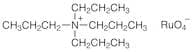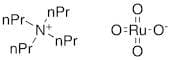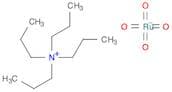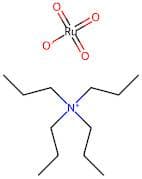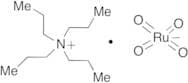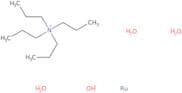
CAS 114615-82-6
:TPAP
- 1-Propanaminium, N,N,N-tripropyl-, (T-4)-tetraoxoruthenate(1-)
- 1-Propanaminium, N,N,N-tripropyl-, (T-4)-tetraoxoruthenate(1-) (1:1)
- Oxido-Trioxo-Ruthenium
- Ruthenate (RuO<sub>4</sub><sup>1-</sup>), (T-4)-, N,N,N-tripropyl-1-propanaminium
- Tetra-n-propylammonium perruthenate
- Tetrapropylammonium
- Tetrapropylammonium perruthenate
- Tetrapropylammonium perruthenate(1-)
- Tetrapropylammonium tetraoxoruthenate
- Tetrapropylammonium tetraoxoruthenate(1-)
- Tpap
- See more synonyms
Tetrapropylammonium Perruthenate
CAS:Formula:C12H28NO4RuColor and Shape:Dark green to Dark blue to Black powder to crystalMolecular weight:351.43Tetra-n-propylammonium perruthenate(VII), 98%
CAS:Tetra-n-propylammonium perruthenate a catalytic oxidant used in conjunction with N-methylmorpholine N-oxide for oxidation of primary secondary alcohols to aldehydes and ketones.This Thermo Scientific Chemicals brand product was originally part of the Alfa Aesar product portfolio. Some documentationFormula:C12H36NO4RuPurity:98%Color and Shape:powder, BlackMolecular weight:359.49Tetrapropylammonium perruthenate, min. 97% TPAP
CAS:Tetrapropylammonium perruthenate, min. 97% TPAP
Formula:(C3H7)4NRuO4Purity:min. 97%Color and Shape:green xtl.Molecular weight:351.431-Propanaminium, N,N,N-tripropyl-, (T-4)-tetraoxoruthenate(1-) (1:1)
CAS:Formula:C12H28NO4RuPurity:97%Color and Shape:SolidMolecular weight:351.4250Tetrapropylammonium perruthenate
CAS:Tetrapropylammonium perruthenateFormula:·C12H28N·O4RuPurity:98%Color and Shape: black solidMolecular weight:351.42502g/molTetrapropylammonium perruthenate
CAS:Formula:C12H28NO4RuPurity:98%Color and Shape:Solid, Dark green solidMolecular weight:351.43Tetrapropylammonium Perruthenate
CAS:Controlled ProductApplications Tetrapropylammonium Perruthenate is used in sustainable oxidation reactions and has potential for chemical recycling.
References Lybaert, J. et al.: Electrochim. Acta., 182, 693 (2015);Formula:C12H28NO4RuColor and Shape:NeatMolecular weight:351.43Tetrapropylammonium perruthenate
CAS:Tetrapropylammonium perruthenate is a polymeric matrix that contains a chelate ligand and can be used as an oxygen sensor. The polymer is synthesized in the presence of trifluoroacetic acid (TFA) using tetrapropylammonium chloride (TPACl) and perruthenate. Tetrapropylammonium perruthenate forms a polymeric matrix with TPACl, which contains a chelate ligand. The polymer is sensitive to changes in the environment such as pH, temperature, and oxidation-reduction potential. The polymeric matrix can be used for sensing the concentration of oxygen in liquid or gas phase by measuring fluorescence intensity at various wavelengths. These measurements are correlated with the concentration of oxygen in the environment.
Formula:C12H28NO4RuPurity:Min. 95%Molecular weight:351.43 g/mol