CAS 1148-11-4
:Benzyloxycarbonyl-L-proline
Description:
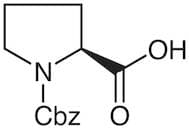
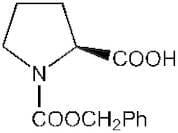
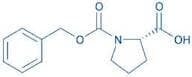
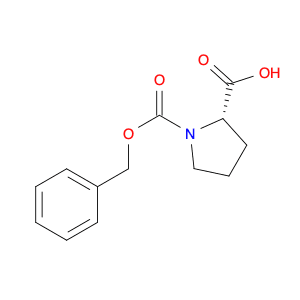
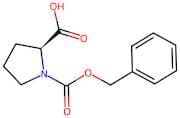
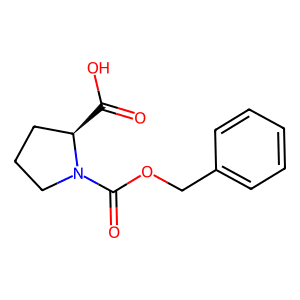
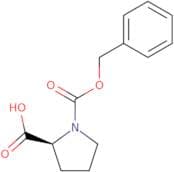
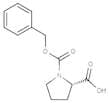
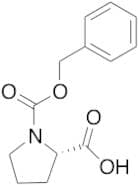
Benzyloxycarbonyl-L-proline, commonly referred to as Z-Proline, is a derivative of the amino acid proline, characterized by the presence of a benzyloxycarbonyl (Z) protecting group. This compound is typically used in peptide synthesis as a protecting group for the amino functionality of proline, which helps to prevent unwanted reactions during the synthesis process. Z-Proline is a white to off-white crystalline solid that is soluble in organic solvents such as methanol and dimethyl sulfoxide, but has limited solubility in water. Its molecular structure includes a proline backbone, which contributes to its unique conformational properties, making it valuable in the design of peptides and proteins. The compound is stable under normal laboratory conditions but may undergo hydrolysis or deprotection under acidic or basic conditions. Due to its role in peptide chemistry, Z-Proline is significant in pharmaceutical research and the development of biologically active compounds. Safety data should be consulted for handling, as with any chemical substance.
Formula:C13H15NO4
InChI:InChI=1S/C13H15NO4/c15-12(16)11-7-4-8-14(11)13(17)18-9-10-5-2-1-3-6-10/h1-3,5-6,11H,4,7-9H2,(H,15,16)/t11-/m0/s1
InChI key:InChIKey=JXGVXCZADZNAMJ-NSHDSACASA-N
SMILES:C(OCC1=CC=CC=C1)(=O)N2[C@H](C(O)=O)CCC2
Synonyms:- (2S)-1,2-Pyrrolidinedicarboxylic acid 1-(phenylmethyl) ester
- (2S)-1-(Benzyloxycarbonyl)pyrrolidine-2-carboxylic acid
- (2S)-1-Phenylmethoxycarbonylpyrrolidine-2-carboxylic acid
- (2S)-1-[(benzyloxy)carbonyl]pyrrolidine-2-carboxylate
- (S)-1-(Benzyloxycarbonyl)pyrrolidine-2-carboxylic acid
- 1,2-Pyrrolidinedicarboxylic acid, 1-(phenylmethyl) ester, (2S)-
- 1,2-Pyrrolidinedicarboxylic acid, 1-(phenylmethyl) ester, (S)-
- 1,2-Pyrrolidinedicarboxylic acid, 1-benzyl ester, <span class="text-smallcaps">L</span>-
- 1,2-Pyrrolidinedicarboxylic acid, 1-benzyl ester, L-
- 1-(Benzyloxycarbonyl)-<span class="text-smallcaps">L</span>-proline
- 1-(Benzyloxycarbonyl)-L-proline
- 1-Carbobenzoxy-<span class="text-smallcaps">L</span>-proline
- 1-Carbobenzoxy-L-proline
- 1-[(Benzyloxy)Carbonyl]Proline
- 1-[(benzyloxy)carbonyl]-D-proline
- 1-[(benzyloxy)carbonyl]-L-proline
- <span class="text-smallcaps">L</span>-Cbz-Proline
- Benzyloxycarbonyl-<span class="text-smallcaps">L</span>-proline
- Benzyloxycarbonyl-L-proline
- Carbobenzoxy-<span class="text-smallcaps">L</span>-proline
- Carbobenzoxy-L-proline
- Carbobenzoxy-S-proline
- Carbobenzyloxy-<span class="text-smallcaps">L</span>-proline
- Carbobenzyloxy-L-proline
- Cbz-<span class="text-smallcaps">L</span>-Pro-OH
- Cbz-L-Pro-OH
- Cbz-L-proline
- N-(Benzyloxycarbonyl)-<span class="text-smallcaps">L</span>-proline
- N-(Carbobenzyloxy)-<span class="text-smallcaps">L</span>-proline
- N-Benzyloxycarbonyl-(S)-proline
- N-Benzyloxycarbonyl-L-prolin
- N-Benzyloxycarbonyl-L-proline
- N-CBZ-L-Proline N-Carbobenzyloxy-L-proline
- N-Carbobenzoxy-<span class="text-smallcaps">L</span>-proline
- N-Carbobenzoxy-L-proline
- N-Carbobenzyloxy-(S)-proline
- N-Cbz-<span class="text-smallcaps">L</span>-proline
- N-Cbz-L-Pro-OH
- N-Cbz-L-proline
- N-[(Phenylmethoxy)carbonyl]-<span class="text-smallcaps">L</span>-proline
- N-[(Phenylmethoxy)carbonyl]-L-proline
- N-benciloxicarbonil-L-prolina
- N-cbz-L-proline crystalline
- Z-L-Proline
- Z-Pro-OH
- N-CARBOBENZYLOXY-L-PROLINE
- N-ALPHA-BENZYLOXYCARBONYL-L-PROLINE
- N-ALPHA-CBZ-L-PROLINE
- (2S)-1-[(BENZYLOXY)CARBONYL]PYRROLIDINE-2-CARBOXYLIC ACID
- CBZ-PRO-OH
- N-ALPHA-CARBOBENZOXY-L-PROLINE
- (S)-N-CBZ-PYRROLIDINE-2-CARBOXYLIC ACID
- N-CBZ-L-PROLINE-OH
- Z-L-PRO-OH
- N-ALPHA-CARBOBENZOXY-L-PYRROLIDINE-2-CARBOXYLIC ACID
- L-CBZ-PROLINE
- See more synonyms
Sort by
Purity (%)
0
100
|
0
|
50
|
90
|
95
|
100
Found 13 products.
N-Benzyloxycarbonyl-L-proline
CAS:Formula:C13H15NO4Purity:>98.0%(T)(HPLC)Color and Shape:White to Almost white powder to crystalMolecular weight:249.27N-Benzyloxycarbonyl-L-proline, 98+%
CAS:N-(Benzyloxycarbonyl)-L-proline is a potent inhibitor of prolidase; a specific peptidase that cleaves dipeptides with a C-terminal prolyl and hydroxylprolyl residue. It is also used in the synthesis of N-(L-Prolyl)--alanine which is a derivative of the naturally occurring beta amino acid -Alanine. TFormula:C13H14NO4Purity:98+%Color and Shape:Powder or crystalline powder or crystals or granules, White to creamMolecular weight:248.26Z-Pro-OH
CAS:Bachem ID: 4001343.
Formula:C13H15NO4Purity:99.1%Color and Shape:WhiteMolecular weight:249.27(2S)-Pyrrolidine-2-carboxylic acid, N-CBZ protected
CAS:(2S)-Pyrrolidine-2-carboxylic acid, N-CBZ protectedFormula:C13H15NO4Purity:98%Color and Shape: white solidMolecular weight:249.26g/molCarbobenzoxyproline
CAS:Carbobenzoxyproline (Carbobenzoxy-S-proline) is a prolidase inhibitor.Formula:C13H15NO4Purity:99.79%Color and Shape:White To Light Yellow Crystal PowderMolecular weight:249.26Z-Pro-OH
CAS:M03066 - Z-Pro-OH
Formula:C13H15NO4Purity:98%Color and Shape:SolidMolecular weight:249.266N-Benzyloxycarbonyl-L-proline
CAS:N-Benzyloxycarbonyl-L-proline is a cationic polymerization inhibitor that has been shown to inhibit the growth of Pseudomonas aeruginosa. It inhibits bacterial growth by inhibiting the production of collagen, an important component in the cell wall. N-Benzyloxycarbonyl-L-proline is also used as a histological staining agent and has been shown to be effective against breast cancer cells resistant to tamoxifen therapy.Formula:C13H15NO4Purity:Min. 95%Color and Shape:PowderMolecular weight:249.26 g/molZ-L-Proline extrapure, 99%
CAS:Formula:C13H15NO4Purity:min. 99%Color and Shape:White, Crystalline powderMolecular weight:249.3N-(Benzyloxycarbonyl)-L-proline
CAS:Controlled ProductApplications N-(Benzyloxycarbonyl)-L-proline is a potent in vitro and in vivo inhibitor of prolidase; a specific peptidase that cleaves dipeptides with a C-terminal prolyl and hydroxylprolyl residue. N-(Benzyloxycarbonyl)-L-proline is also used in the synthesis of N-(L-Prolyl)-β-alanine (P756190) which is a derivative of the naturally occurring beta amino acid β-Alanine (A637320).
References Lupi, A., et al.: BBA-Mol. Cell Res., 1744, 157 (2005)Formula:C13H15NO4Color and Shape:NeatMolecular weight:249.26