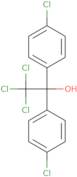
CAS 115-32-2
:dicofol
Description:
Dicofol is an organochlorine compound primarily used as a pesticide, particularly for controlling mites on various crops. It is characterized by its chemical structure, which includes a chlorinated phenolic group, contributing to its effectiveness as an acaricide. Dicofol is typically a colorless to pale yellow liquid with a faint odor and is relatively stable under normal conditions. It exhibits low solubility in water but is soluble in organic solvents, which facilitates its application in agricultural settings. The compound has a moderate to high toxicity profile for aquatic organisms, raising environmental concerns regarding its use. Additionally, dicofol is known to bioaccumulate in the food chain, leading to potential long-term ecological impacts. Regulatory scrutiny has increased over the years due to its persistence in the environment and potential health risks to humans and wildlife. As a result, its use has been restricted or banned in several countries, prompting the search for safer alternatives in pest management.
Formula:C14H9Cl5O
InChI:InChI=1/C14H9Cl5O/c15-11-5-1-9(2-6-11)13(20,14(17,18)19)10-3-7-12(16)8-4-10/h1-8,20H
InChI key:InChIKey=UOAMTSKGCBMZTC-UHFFFAOYSA-N
SMILES:C(C(Cl)(Cl)Cl)(O)(C1=CC=C(Cl)C=C1)C2=CC=C(Cl)C=C2
Synonyms:- 1,1-Bis(4-chlorophenyl)-2,2,2-trichloroethanol
- 1,1-Bis(p-chlorophenyl)-2,2,2-trichloroethanol
- 2,2,2-Trichloro-1,1-Bis(4-Chlorophenyl)Ethanol
- 2,2,2-Trichloro-1,1-bis(p-chlorophenyl)ethanol
- 2,2,2-Trichloro-1,1-di(4-chlorophenyl)ethanol
- 4,4'-Dichloro-α-(trichloromethyl)benzhydrol
- 4-Chloro-Α-(4-Chlorophenyl)-Α-(Trichloromethyl)Benzenemethanol
- Acarin
- Afd 25
- Agravertin
- Benzenemethanol, 4-chloro-α-(4-chlorophenyl)-α-(trichloromethyl)-
- Benzhydrol, 4,4'-dichloro-α-(trichloromethyl)-
- Chloretanol
- Colonel-S
- Cpca
- Dacomain
- Decofol
- Dichlorokelthane
- Dicofo
- Dicofol [Benzenemethanol, 4-chloro-α-(4-chlorophenyl)-α-(trichloromethyl)-]
- Dicofol kelthene
- Dtmc
- Ent 23,648
- Ethanol, 2,2,2-trichloro-1,1-bis(4-chlorophenyl)-
- Fw 293
- Keltane
- Kelthane
- Kelthane A
- Kelthanethanol
- Milbol
- Mitigan
- p,p'-Dicofol
- p,p'-Kelthane
- 1,1,1-Trichlor-2,2-bis(4-chlorphenyl)-aethanol
- DI(P-CHLOROPHENYL)TRICHLOROMETHYL-CARBINOL
- FW 293(R)
- 1,1-Bis-(chlorophenyl)-2,2,2-trichloroethanol
- CEKUDIFOL
- KELTHANE (TM)
- DICOFOL
- DICOCHEM
- 4,4'-Dichloro-alpha-(trichloromethyl)benzhydrol
- 1,1,1-TRICHLORO-2,2-BIS-(4-CHLOROPHENYL)-ETHANOL
- AGROTHANE
- DTMC(R)
- See more synonyms
Filter by
Purity percentage
0
100
|
0
|
50
|
90
|
95
|
100
- Lower prices
- Higher prices
- Lower purities
- Higher purities
- Faster estimated delivery
Dicofol-13C12
CAS:Controlled ProductFormula:C14H9Cl5OColor and Shape:COLOURLESS CRYSTALS.Molecular weight:370.5Dicofol in Methanol
CAS:Controlled ProductMethanolFormula:C14H9Cl5OColor and Shape:COLOURLESS CRYSTALS.Molecular weight:370.5Dicofol
CAS:Controlled ProductDicofol is a pyrimidine compound with a methyl myristate group at the C-4 position. It is synthesized by bacteria and has been used as an insecticide for over 50 years. Dicofol also inhibits cell growth in some bacterial strains, including high-resistance bacterial strains. Dicofol does not have any significant effect on ryanodine receptor activity in plant tissues, but it does inhibit the release of calcium from the endoplasmic reticulum. The presence of dicofol can be detected using analytical chemistry methods that are sensitive to picomolar concentrations.
Formula:C14H9Cl5OPurity:Min. 85 Area-%Color and Shape:Red Clear LiquidMolecular weight:370.48 g/mol