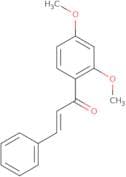
CAS 1154-77-4
:1-(2,4-Dimethoxyphenyl)-3-phenyl-2-propen-1-one
Description:
1-(2,4-Dimethoxyphenyl)-3-phenyl-2-propen-1-one, also known as a type of chalcone, is an organic compound characterized by its conjugated double bond system, which contributes to its reactivity and potential biological activity. This compound features a central α,β-unsaturated carbonyl group flanked by two aromatic rings, one of which is substituted with two methoxy groups at the 2 and 4 positions. The presence of these methoxy groups enhances the compound's lipophilicity and may influence its interaction with biological targets. Chalcones are known for their diverse pharmacological properties, including anti-inflammatory, antioxidant, and anticancer activities. The compound's structure allows for various chemical modifications, making it a valuable scaffold in medicinal chemistry. Additionally, its solubility and stability can vary depending on the solvent and environmental conditions, which are important factors to consider in both laboratory and industrial applications. Overall, 1-(2,4-Dimethoxyphenyl)-3-phenyl-2-propen-1-one represents a significant class of compounds with potential therapeutic applications.
Formula:C17H16O3
InChI:InChI=1S/C17H16O3/c1-19-14-9-10-15(17(12-14)20-2)16(18)11-8-13-6-4-3-5-7-13/h3-12H,1-2H3
InChI key:InChIKey=ZRDCNUALRUCCPA-UHFFFAOYSA-N
SMILES:C(C=CC1=CC=CC=C1)(=O)C2=C(OC)C=C(OC)C=C2
Synonyms:- (2E)-1-(2,4-dimethoxyphenyl)-3-phenylprop-2-en-1-one
- 1-(2,4-Dimethoxyphenyl)-3-phenyl-2-propen-1-one
- 2-Propen-1-one, 1-(2,4-dimethoxyphenyl)-3-phenyl-
- 2′,4′-Dimethoxychalcone
- Chalcone, 2',4'-dimethoxy-
- Chalcone, 2′,4′-dimethoxy-
Sort by
Purity (%)
0
100
|
0
|
50
|
90
|
95
|
100
Found 2 products.
2',4'-Dimethoxychalcone
CAS:2',4'-Dimethoxychalcone is a chalcone that has been shown to have anticancer properties. It inhibits the growth of cancer cells by binding to tetraethylammonium, which prevents the formation of reactive oxygen species and increases the production of glutathione. 2',4'-Dimethoxychalcone also inhibits phosphorylation and stabilizes proteins through its interaction with chaperone proteins, such as hsp90. This compound has been shown to reduce pain in animals by inhibiting the release of substance P from peripheral nerve endings. The anti-nociceptive effect is systemic and not localized, which means it does not depend on a specific receptor and can be used for the treatment of pain associated with various diseases and conditions.
Formula:C17H16O3Purity:Min. 95%Molecular weight:268.31 g/mol(2E)-1-(2,4-dimethoxyphenyl)-3-phenylprop-2-en-1-one
CAS:Formula:C17H16O3Purity:95.0%Molecular weight:268.312