CAS 115491-93-5
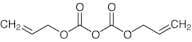
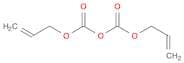
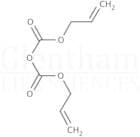
:diallyl dicarbonate
Description:
Diallyl dicarbonate (CAS 115491-93-5) is an organic compound characterized by its structure, which features two allyl groups attached to a dicarbonate moiety. This colorless to pale yellow liquid is known for its low viscosity and pleasant odor. It is soluble in organic solvents such as ethanol and acetone but has limited solubility in water. Diallyl dicarbonate is primarily used as a reagent in organic synthesis and as a polymerization agent, particularly in the production of various resins and plastics. It exhibits properties such as being a reactive monomer, which allows it to participate in cross-linking reactions, enhancing the mechanical properties of the resulting materials. Additionally, it has applications in the food industry as a preservative due to its antimicrobial properties. However, it should be handled with care, as it can be irritating to the skin and eyes, and proper safety measures should be observed during its use. Overall, diallyl dicarbonate is a versatile compound with significant industrial applications.
Formula:C8H10O5
InChI:InChI=1/C8H10O5/c1-3-5-11-7(9)13-8(10)12-6-4-2/h3-4H,1-2,5-6H2
SMILES:C=CCOC(=O)OC(=O)OCC=C
Synonyms:- Diallyldicarbonate
- Diallyl pyrocarbonate
- Pyrocarbonic acid diallyl ester
- Diprop-2-En-1-Yl Dicarbonate
Sort by
Purity (%)
0
100
|
0
|
50
|
90
|
95
|
100
Found 5 products.
Diallyl Dicarbonate
CAS:Formula:C8H10O5Purity:>90.0%(T)Color and Shape:Colorless to Light yellow to Light orange clear liquidMolecular weight:186.16DICARBONIC ACID, 1,3-DI-2-PROPEN-1-YL ESTER
CAS:Formula:C8H14O6Purity:95%Color and Shape:LiquidMolecular weight:206.1932Diallyl dicarbonate
CAS:Diallyl dicarbonate is a reactive molecule that can undergo oxidation-reduction reactions. It has an optical property of being able to absorb ultraviolet light and emit infrared light. Diallyl dicarbonate can also react with metal carbonyls to form allyl carbonates, which are related to the profile of molecules with carbonyl groups. This compound is a low expression product, meaning that it is not found in all cells. Diallyl dicarbonate also reacts with hydroxyl groups and heterocycles, showing metabolic disorders in tumour cell lines.Formula:C8H10O5Purity:Min. 95%Molecular weight:186.16 g/mol