


CAS 1158560-99-6
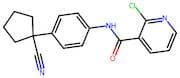
:2-chloro-N-[4-(1-cyanocyclopentyl)phenyl]-3-Pyridinecarboxamide
3-PyridinecarboxaMide, 2-chloro-N-[4-(1-cyanocyclopentyl)phenyl]
CAS:Formula:C18H16ClN3OPurity:97%Color and Shape:SolidMolecular weight:325.79212-Chloro-N-(4-(1-cyanocyclopentyl)phenyl)nicotinamide
CAS:2-Chloro-N-(4-(1-cyanocyclopentyl)phenyl)nicotinamidePurity:97%Molecular weight:325.8g/mol2-Chloro-N-[4-(1-cyanocyclopentyl)phenyl]-3-pyridinecarboxamide-d8
CAS:Controlled ProductApplications 2-Chloro-N-[4-(1-cyanocyclopentyl)phenyl]-3-pyridinecarboxamide-d8 is an intermediate used in the synthesis of Apatinib-d8 Hydrochloride (A726152), which is a labelled Apatinib (A726150). Apatinib is an orally available, small molecule multitargeted tyrosine kinase inhibitor. Apatinib selectively inhibits the vascular endothelial growth factor receptor-2 (VEGFR2). Apatinib functions by inhibiting VEGF-mediated endothelial cell migration and proliferation thus blocking new blood vessel formation in tumor tissue. Recent studies have shown that Apatinib enhances the efficacy of conventional chemotherapeutical drugs in side population (SP) cells and ABCB1-overexpressing leukemia cells.
References Mi, Y. et al.: Cancer Res., 70, 7981 (2010); Tong, X.Z. et al.: Biochem. Pharmacol., 83, 586 (2012); Ding, J, et al.: J. Chrom B Anal. Technol. Biomed. Life Sci., 895, 108 (2012);Formula:C18D8H8ClN3OColor and Shape:NeatMolecular weight:333.8412-Chloro-N-[4-(1-cyanocyclopentyl)phenyl]-3-pyridinecarboxamide
CAS:Controlled ProductApplications 2-Chloro-N-[4-(1-cyanocyclopentyl)phenyl]-3-pyridinecarboxamide is an intermediate Apatinib 25-N-Oxide (A726160), a metabolite of the antiangiogenic agent and selective VEGFR2 inhibitor Apatinib (A726150).
Formula:C18H16ClN3OColor and Shape:NeatMolecular weight:325.79
![3-PyridinecarboxaMide, 2-chloro-N-[4-(1-cyanocyclopentyl)phenyl]](/_next/image/?url=https%3A%2Fstatic.cymitquimica.com%2Fproducts%2FIN%2Fthumb%2FDA008U0G.jpg&w=3840&q=75)


![2-Chloro-N-[4-(1-cyanocyclopentyl)phenyl]-3-pyridinecarboxamide-d8](/_next/image/?url=https%3A%2Fstatic.cymitquimica.com%2Fproducts%2FTR%2Fthumb%2FC364966.jpg&w=3840&q=75)

![2-Chloro-N-[4-(1-cyanocyclopentyl)phenyl]-3-pyridinecarboxamide](/_next/image/?url=https%3A%2Fstatic.cymitquimica.com%2Fproducts%2FTR%2Fthumb%2FC364965.jpg&w=3840&q=75)