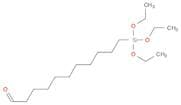
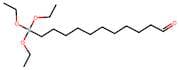
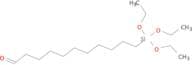
CAS 116047-42-8
:11-(triethoxysilyl)undecanal
- Undecanal, 11-(Triethoxysilyl)-
- 11-(Triethoxysilyl)undecanal
- Triethoxysilylundecanal, tech -95
- TRIETHOXYSILYLUNDECANAL
11-(Triethoxysilyl)undecanal
CAS:Formula:C17H36O4SiPurity:95%Color and Shape:LiquidMolecular weight:332.5508Triethoxysilylundecanal
CAS:S25280 - Triethoxysilylundecanal
Formula:C17H36O4SiPurity:techColor and Shape:Liquid, ClearMolecular weight:332.556TRIETHOXYSILYLUNDECANAL, tech
CAS:Aldehyde Functional Trialkoxy Silane
Silane coupling agents have the ability to form a durable bond between organic and inorganic materials to generate desired heterogeneous environments or to incorporate the bulk properties of different phases into a uniform composite structure. The general formula has two classes of functionality. The hydrolyzable group forms stable condensation products with siliceous surfaces and other oxides such as those of aluminum, zirconium, tin, titanium, and nickel. The organofunctional group alters the wetting or adhesion characteristics of the substrate, utilizes the substrate to catalyze chemical transformations at the heterogeneous interface, orders the interfacial region, or modifies its partition characteristics, and significantly effects the covalent bond between organic and inorganic materials.
Triethoxysilylundecanal
Treated surface contact angle, water: 70°Long chain coupling agent for DNAProvides greater stability for coupled proteins than shorter alkyl homologsLong chain homolog of triethoxysilylbutyraldehyde (SIT8185.3)Formula:C17H36O4SiPurity:techColor and Shape:Straw LiquidMolecular weight:332.56