CAS 116883-12-6
:BOC-LYS-AMC
Description:
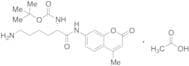
BOC-LYS-AMC, also known as Nα-Boc-Lysine-7-amido-4-methylcoumarin, is a chemical compound commonly used in biochemical research, particularly in the study of proteases and enzyme activity. It features a Boc (tert-butyloxycarbonyl) protecting group on the lysine amino acid, which enhances its stability and solubility in organic solvents. The presence of the AMC (7-amido-4-methylcoumarin) moiety allows for fluorescence-based detection, making it a valuable substrate for monitoring enzymatic reactions. This compound is typically utilized in assays to measure protease activity, as the cleavage of the peptide bond releases the fluorescent AMC, which can be quantified. BOC-LYS-AMC is generally soluble in polar organic solvents and exhibits stability under standard laboratory conditions. Its structural characteristics enable it to participate in various chemical reactions, making it a versatile tool in synthetic and analytical chemistry. As with all chemical substances, proper handling and safety precautions should be observed when working with BOC-LYS-AMC.
Formula:C21H29N3O5
Synonyms:- Boc-Lysine-Amc
- Boc-L-Lysine 7-Amido-4-Methylcoumarin
- N-Alpha-T-Butoxycarbonyl-L-Lysine 7-Amido-4-Methylcoumarin
Sort by
Purity (%)
0
100
|
0
|
50
|
90
|
95
|
100
Found 2 products.
Boc-Lys-AMC
CAS:Bachem ID: 4033973.
Formula:C21H29N3O5Color and Shape:White PowderMolecular weight:403.48Boc-L-Lys-Amc Acetic Acid Salt (~90%)
CAS:Controlled ProductStability Hygroscopic
Applications iBoc-L-Lys-Amc, s an analytical reagent used to study homogeneous nonisotopic histone deacetylase activity fluorescence assay.
References Heltweg, B., et al.: Journal of Biomolecular Screening, Vol. 8, Iss.1P 89-95 (2003);Formula:C21H29N3O5·CH3COOHPurity:~90%Color and Shape:NeatMolecular weight:403.5