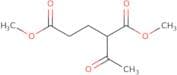
CAS 116981-01-2
:1,5-Dimethyl 2-acetylpentanedioate
Description:
1,5-Dimethyl 2-acetylpentanedioate, with the CAS number 116981-01-2, is an organic compound characterized by its ester functional groups and a pentanedioate backbone. This compound features two methyl groups located at the 1 and 5 positions of the pentanedioate chain, contributing to its structural complexity and potential for various chemical reactivity. The presence of an acetyl group at the 2-position enhances its reactivity, making it a useful intermediate in organic synthesis. Typically, such compounds exhibit moderate solubility in organic solvents and may have limited solubility in water due to their hydrophobic alkyl groups. The compound's molecular structure suggests it may participate in reactions typical of esters, such as hydrolysis and transesterification. Additionally, its unique arrangement of functional groups may impart specific properties, such as flavor or fragrance characteristics, making it of interest in the food and fragrance industries. Safety data should be consulted for handling and storage, as with all chemical substances, to ensure proper precautions are taken.
Formula:C9H14O5
InChI:InChI=1S/C9H14O5/c1-6(10)7(9(12)14-3)4-5-8(11)13-2/h7H,4-5H2,1-3H3
InChI key:InChIKey=NAGJUTYGIQTFNJ-UHFFFAOYSA-N
SMILES:C(CCC(OC)=O)(C(OC)=O)C(C)=O
Synonyms:- Pentanedioic acid, 2-acetyl-, dimethyl ester
- 1,5-Dimethyl 2-acetylpentanedioate
- Dimethyl 2-acetylglutarate
- Pentanedioic acid, 2-acetyl-, 1,5-dimethyl ester
Sort by
Purity (%)
0
100
|
0
|
50
|
90
|
95
|
100
Found 1 products.
1,5-Dimethyl 2-acetylpentanedioate
CAS:1,5-Dimethyl 2-acetylpentanedioate is an organic compound that contains a cyclobutane ring. The titanium tetrachloride reacts with this compound to produce 1,5-dimethylcyclobutanes and titanium tetrachloride. This reaction is stereoselective, meaning that it only occurs if the reactant molecules are in a specific orientation. Silylation of the carbonyl groups at the end of each ring yields two products: dimethylsilyl ethers and dianions. The dianions are then cyclized to form a cyclopropane ring with two methyl groups on one side of the ring and one on the other. This product may be used as a precursor for other compounds containing cyclopropane rings.
Formula:C9H14O5Purity:Min. 95%Molecular weight:202.2 g/mol