CAS 117-08-8
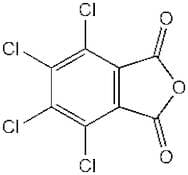
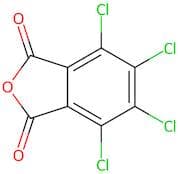
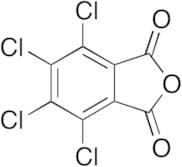
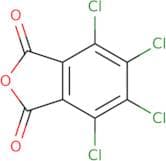
:Tetrachlorophthalic anhydride
Description:
Tetrachlorophthalic anhydride (CAS 117-08-8) is a chemical compound characterized by its anhydride functional group derived from phthalic acid, with four chlorine atoms substituted on the aromatic ring. It appears as a white to light yellow crystalline solid and is known for its high melting point and low solubility in water, making it more soluble in organic solvents. This compound is primarily used in the production of polyimides and other polymers, serving as a key intermediate in various chemical syntheses. Its reactivity is notable, as it can undergo hydrolysis to form tetrachlorophthalic acid, and it can also participate in reactions with nucleophiles due to the electrophilic nature of the anhydride group. Tetrachlorophthalic anhydride is considered hazardous, with potential health effects upon exposure, necessitating appropriate safety measures during handling. Its applications extend to the manufacturing of coatings, adhesives, and as a chemical intermediate in the synthesis of other compounds, highlighting its significance in industrial chemistry.
Formula:C8Cl4O3
InChI:InChI=1S/C8Cl4O3/c9-3-1-2(8(14)15-7(1)13)4(10)6(12)5(3)11
InChI key:InChIKey=AUHHYELHRWCWEZ-UHFFFAOYSA-N
SMILES:ClC1=C2C(=C(Cl)C(Cl)=C1Cl)C(=O)OC2=O
Synonyms:- (2,3,6-Trichlorophenyl)Acetic Acid
- 1,3-Dioxy-4,5,6,7-tetrachloroisobenzofuran
- 1,3-Isobenzofurandione, 4,5,6,7-Tetrachloro
- 3,4,5,6-Tetrachlorophthalic anhydride
- 4,5,6,7-Tetrachloro-1,3-isobenzofurandione
- 4,5,6,7-Tetrachloro-2-Benzofuran-1,3-Dione
- 4,5,6,7-Tetrachloroisobenzofuran-1,3-dione
- 4,5,6,7-Tetrachlorp-l,3-dioxoph-thalan
- NSC 1484
- Niagathal
- Phthalic anhydride, tetrachloro-
- Tetra Chloro Phthalic Anhydride
- Tetrachloro Phthalic Anhydride
- Tetrachlorophthalic acid anhydride
- See more synonyms
Sort by
Purity (%)
0
100
|
0
|
50
|
90
|
95
|
100
Found 4 products.
Tetrachlorophthalic anhydride, 98%
CAS:Protection of amines as their tetrachlorophthalimide derivatives, by reaction with the anhydride in the presence of triethylamine, has been found to be useful in oligosaccharide chemistry. The group is stable to a wide range of reagents but can be selectively cleaved with ethylenediamine at lower teFormula:C8Cl4O3Purity:98%Color and Shape:White, Powder or crystalline powderMolecular weight:285.89Tetrachlorophthalic anhydride
CAS:Tetrachlorophthalic anhydrideFormula:C8Cl4O3Purity:97%Color and Shape: white powderMolecular weight:285.90g/molTetrachlorophthalic Anhydride
CAS:Controlled ProductApplications Tetrachlorophthalic Anhydride is used in the synthesis of nucleoside analogues with a specific structure as apoptosis inducing active compounds. Also used in the synthesis of carbonic anhydrase inhbitors. Chlorinated Reactive Flame Retardant Intermediate
References Hirschhaeuser, C. et al.: Chem. A. Eur. J., 19, 13017 (2013); Sethi, K. et al.: Bioorg. Med. Chem., 21, 5168 (2013);Formula:C8Cl4O3Color and Shape:NeatMolecular weight:285.9Tetrachlorophthalic anhydride
CAS:Controlled ProductTetrachlorophthalic anhydride (TCPA) is a reactive chemical that has been shown to have anti-inflammatory activity. TCPA has been found to inhibit the release of histamine from mast cells in humans, and it inhibits the production of pro-inflammatory cytokines such as tumor necrosis factor alpha (TNF-α). TCPA has also been shown to have a toxic effect on human lymphocyte transformation, which may be due to its ability to induce apoptosis. The toxicity of TCPA was studied in rats and mice, where it was found that TCPA did not cause any significant changes in clinical pathology or hydroxyl group levels.Formula:C8Cl4O3Purity:Min. 97.5 Area-%Color and Shape:White/Off-White SolidMolecular weight:285.89 g/mol