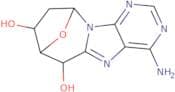
CAS 117182-88-4
:8,5′-Cyclo-2′-deoxyadenosine
Description:
8,5′-Cyclo-2′-deoxyadenosine is a modified nucleoside that features a unique cyclization between the 8-position of the adenine base and the 5′-position of the sugar moiety, resulting in a bicyclic structure. This compound is a derivative of 2′-deoxyadenosine, which is a building block of DNA. The cyclization alters the conformational properties and stability of the nucleoside, potentially influencing its biological activity and interactions with enzymes and nucleic acids. It is of interest in biochemical research, particularly in studies related to DNA repair mechanisms and the effects of structural modifications on nucleic acid function. The compound may exhibit distinct pharmacological properties, making it a candidate for further investigation in medicinal chemistry. Its CAS number, 117182-88-4, allows for precise identification in chemical databases and literature. Overall, 8,5′-Cyclo-2′-deoxyadenosine represents a significant modification in the study of nucleosides and their roles in cellular processes.
Formula:C10H11N5O3
InChI:InChI=1S/C10H11N5O3/c11-8-5-9(13-2-12-8)15-4-1-3(16)7(18-4)6(17)10(15)14-5/h2-4,6-7,16-17H,1H2,(H2,11,12,13)/t3-,4+,6+,7-/m0/s1
InChI key:InChIKey=MBVGIEDXZGVICG-HPQVQDLLSA-N
SMILES:O[C@H]1C=2N(C=3C(N2)=C(N)N=CN3)[C@@]4(O[C@]1([C@@H](O)C4)[H])[H]
Synonyms:- (6S,7S,8S,10R)-4-Amino-7,8,9,10-tetrahydro-7,10-epoxy-6H-azepino[1,2-e]purine-6,8-diol
- 7,10-Epoxy-6H-azepino[1,2-e]purine-6,8-diol, 4-amino-7,8,9,10-tetrahydro-, (6S,7S,8S,10R)-
- 8,5′-Cyclo-2′-deoxyadenosine
- (S)-5′,8-Cyclopurine adenine
- 7,10-Epoxy-6H-azepino[1,2-e]purine-6,8-diol, 4-amino-7,8,9,10-tetrahydro-, [6S-(6α,7β,8β,10β)]-
Sort by
Purity (%)
0
100
|
0
|
50
|
90
|
95
|
100
Found 1 products.
(5'S)-2'-Deoxy-8,5'-cycloadenosine
CAS:<p>(5'S)-2'-Deoxy-8,5'-cycloadenosine is a nucleoside analog that blocks the synthesis of DNA. It is a glycosylated nucleoside that contains an 8-carbon fatty acid chain linked to the 5’ carbon of the sugar ring. This compound is formed from the reaction of (5'S)-2'-deoxyadenosine and dicyclohexylcarbodiimide. The biological properties of this drug are not well understood, but it has been shown to be reactive with physiological levels and able to induce neuronal death in an experimental model. The mechanism for this effect is unknown, but may involve intramolecular hydrogen bonding or hydrolysis by esterases. A molecular docking analysis was performed to study the binding affinity between (5'S)-2'-deoxy-8,5'-cycloadenosine and human mda-mb-231 breast cancer cells. This analysis showed that wild</p>Formula:C10H11N5O3Purity:Min. 95%Molecular weight:249.23 g/mol