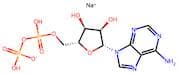
CAS 1172-42-5
:Adenosine 5′-(trihydrogen diphosphate), sodium salt (1:1)
Description:
Adenosine 5′-(trihydrogen diphosphate), sodium salt (1:1), commonly referred to as ADP or adenosine diphosphate, is a nucleotide that plays a crucial role in cellular energy transfer. It consists of an adenosine molecule bonded to two phosphate groups, with the sodium salt form indicating the presence of sodium ions that balance the negative charges of the phosphate groups. This compound is typically a white to off-white powder, highly soluble in water, and exhibits a slightly acidic pH in solution. ADP is essential in metabolic processes, particularly in the synthesis of ATP (adenosine triphosphate), serving as a substrate for kinases in phosphorylation reactions. It also participates in signaling pathways and energy metabolism. The presence of sodium enhances its stability and solubility, making it suitable for various biochemical applications, including research and therapeutic uses. As a biochemical reagent, ADP is vital in studies involving enzymatic activity, energy transfer, and cellular signaling mechanisms.
Formula:C10H15N5O10P2·Na
InChI:InChI=1S/C10H15N5O10P2.Na/c11-8-5-9(13-2-12-8)15(3-14-5)10-7(17)6(16)4(24-10)1-23-27(21,22)25-26(18,19)20;/h2-4,6-7,10,16-17H,1H2,(H,21,22)(H2,11,12,13)(H2,18,19,20);/t4-,6-,7-,10-;/m1./s1
InChI key:InChIKey=CWQZLWSOTXCGNT-MCDZGGTQSA-N
SMILES:O[C@H]1[C@H](N2C=3C(N=C2)=C(N)N=CN3)O[C@H](COP(OP(=O)(O)O)(=O)O)[C@H]1O.[Na]
Synonyms:- Adenosine 5′-(trihydrogen pyrophosphate), monosodium salt
- Adenosine 5′-(trihydrogen diphosphate), sodium salt (1:1)
- Sodium ADP
- Adenosine 5′-(trihydrogen diphosphate), monosodium salt
- Adenosine 5′-pyrophosphate, sodium salt
Sort by
Purity (%)
0
100
|
0
|
50
|
90
|
95
|
100
Found 2 products.
Adenosine-5′-diphosphate monosodium salt
CAS:Formula:C10H14N5NaO10P2Purity:98%Color and Shape:SolidMolecular weight:449.1830Sodium ((2R,3S,4R,5R)-5-(6-amino-9H-purin-9-yl)-3,4-dihydroxytetrahydrofuran-2-yl)methyl dihydrogendiphosphate
CAS:Sodium ((2R,3S,4R,5R)-5-(6-amino-9H-purin-9-yl)-3,4-dihydroxytetrahydrofuran-2-yl)methyl dihydrogendiphosphatePurity:98%Molecular weight:449.19g/mol