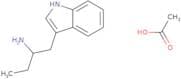
CAS 118-68-3
:Etryptamine acetate
Description:
Etryptamine acetate, with the CAS number 118-68-3, is a chemical compound that belongs to the class of tryptamines, which are derived from the amino acid tryptophan. This substance is characterized by its indole structure, which is a fused ring system consisting of a benzene ring and a pyrrole ring. Etryptamine acetate is typically encountered as a white to off-white crystalline solid and is soluble in organic solvents. It exhibits psychoactive properties, similar to other tryptamines, and is often studied for its potential effects on the central nervous system. The acetate group in its name indicates that it is an acetate ester, which can influence its solubility and reactivity. As with many tryptamines, it may interact with serotonin receptors, making it of interest in pharmacological research. However, due to its psychoactive nature, it is important to handle this compound with caution and be aware of its legal status in various jurisdictions.
Formula:C12H16N2·C2H4O2
InChI:InChI=1S/C12H16N2.C2H4O2/c1-2-10(13)7-9-8-14-12-6-4-3-5-11(9)12;1-2(3)4/h3-6,8,10,14H,2,7,13H2,1H3;1H3,(H,3,4)
InChI key:InChIKey=TUQLBJAHRWROHB-UHFFFAOYSA-N
SMILES:C(C(CC)N)C=1C=2C(NC1)=CC=CC2.C(C)(O)=O
Synonyms:- (±)-α-Ethyltryptamine acetate
- 1-(1H-indol-3-yl)butan-2-amine
- 1-(1H-indol-3-yl)butan-2-amine acetate (1:1)
- 1H-Indole-3-ethanamine, α-ethyl-, acetate (1:1)
- 1H-Indole-3-ethanamine, α-ethyl-, monoacetate
- 3-(2-Aminobutyl)indole acetate
- ALPHA-Ethyltryptamine acetate
- Indole, 3-(2-aminobutyl)-, acetate
- Indole, 3-(2-aminobutyl)-, monoacetate
- Monase
- NSC 63963
Sort by
Purity (%)
0
100
|
0
|
50
|
90
|
95
|
100
Found 1 products.
α-Ethyltryptamine acetate
CAS:Controlled ProductAlpha-ethyltryptamine acetate is a diagnostic agent that is used to identify streptococcus faecalis. It is hydrolyzed by fatty acid hydroxylases to form the corresponding fatty alcohol, which can then be oxidized by fatty acid oxidases to produce the corresponding ketone. Alpha-ethyltryptamine acetate has been shown to have an inhibitory effect on uptake of serotonin by serotonergic neurons in rats. This effect may be due to its ability to act as a substrate for transporter gene function.Formula:C12H16N2·C2H4O2Purity:Min. 95%Molecular weight:248.32 g/mol