CAS 1182-42-9
:Cholesteryl caprylate
Description:
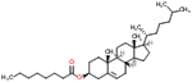
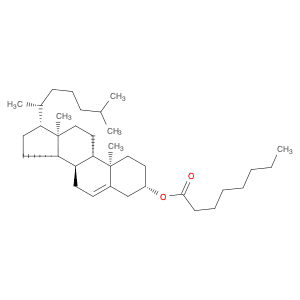
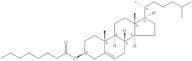
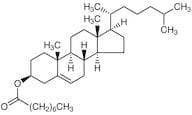
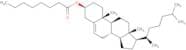
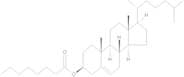
Cholesteryl caprylate, with the CAS number 1182-42-9, is an ester formed from cholesterol and caprylic acid (octanoic acid). This compound is characterized by its hydrophobic nature due to the long hydrocarbon chains, which contributes to its solubility in organic solvents while being poorly soluble in water. Cholesteryl caprylate is often utilized in pharmaceutical formulations, particularly in drug delivery systems, due to its ability to enhance the solubility and bioavailability of lipophilic drugs. It exhibits properties typical of lipid-based excipients, such as stability and compatibility with various active pharmaceutical ingredients. Additionally, it may have applications in the cosmetic industry, where it can serve as an emollient or skin-conditioning agent. The compound's structure includes a steroid backbone from cholesterol, which imparts specific biological activities, potentially influencing membrane fluidity and cellular interactions. Overall, cholesteryl caprylate is valued for its functional properties in both medicinal and cosmetic applications.
Formula:C35H60O2
InChI:InChI=1S/C35H60O2/c1-7-8-9-10-11-15-33(36)37-28-20-22-34(5)27(24-28)16-17-29-31-19-18-30(26(4)14-12-13-25(2)3)35(31,6)23-21-32(29)34/h16,25-26,28-32H,7-15,17-24H2,1-6H3/t26-,28+,29+,30-,31+,32+,34+,35-/m1/s1
InChI key:InChIKey=SKLBBRQPVZDTNM-SJTWHRLHSA-N
SMILES:C[C@@]12[C@@]3([C@]([C@]4([C@](C)(CC3)[C@@]([C@@H](CCCC(C)C)C)(CC4)[H])[H])(CC=C1C[C@@H](OC(CCCCCCC)=O)CC2)[H])[H]
Synonyms:- (3Beta)-Cholest-5-En-3-Yl Octanoate
- 3β-(Octanoyloxy)cholest-5-ene
- 5-Cholesten-3β-ol caprylate
- Caprylic acid cholesterol ester
- Cholest-5-Ene-3-Beta-Yl Octanoate
- Cholest-5-en-3-ol (3β)-, 3-octanoate
- Cholest-5-en-3-ol (3β)-, octanoate
- Cholest-5-en-3β-ol caprylate
- Cholesterol caprylate
- Cholesterol n-caprylate
- Cholesterol, octanoate
- Cholesteryl octanoate
- See more synonyms
Sort by
Purity (%)
0
100
|
0
|
50
|
90
|
95
|
100
Found 9 products.
Cholesteryl Caprylate
CAS:Saturated acyclic monocarboxylic acids and their anhydrides, halides, peroxides etc, nesoiFormula:C35H60O2Color and Shape:White PowderMolecular weight:512.45933Cholesterol n-Octanoate
CAS:Formula:C35H60O2Purity:>95.0%(GC)Color and Shape:White to Almost white powder to crystalMolecular weight:512.86Cholesterol n-Octanoate
CAS:Controlled ProductCholesterol n-Octanoate is a chiral compound that belongs to the group of p2, film-forming polymers. This polymer is used in laboratories for diagnosis, and also as an adjunct in the treatment of pancreatic disorders. Cholesteryl esters are produced by the hydrolysis of cholesterol esterase (CE) with the addition of cholesteryl acetate and a fatty acid. The activation energy for this reaction is 14.5 kcal/mol. CE activity is inhibited by lipolytic enzymes such as pancreatic lipase and hepatic lipase. In humans CEs are located primarily in the liver, with smaller amounts found in the intestines, adrenal cortex, testes, ovaries, placenta, adipose tissue, and other organs.Formula:C35H60O2Purity:Min. 95%Color and Shape:PowderMolecular weight:512.85 g/molCholesterol Caprylate
CAS:Controlled ProductApplications Cholesterol Caprylate is a Cholesterol (C432501) derivative. Cholesterol (C432501) is a major component of all biological membranes; ~25% of total brain lipid is Cholesterol. Cholesterol is the principal sterol of the higher animals. Cholesterol was found in all body tissues, especial in the brain, spinal cord, and in animal fats or oils. Cholesterol is the main constituent of gallstones.
References Rosin, Z., et al.: Physiol. Chem., 124, 282 (1923), Schoenheimer, et al.: J. Biol. Chem., 105, 355 (1934), Gemant, et al.: Life Sci., 1, 233 (1962), Johnson, K., et al.: 4, 457 (1964),Formula:C35H60O2Color and Shape:NeatMolecular weight:512.85