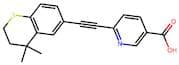
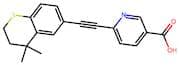
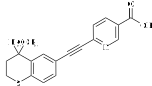
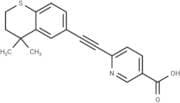
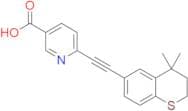
CAS 118292-41-4
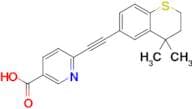
:Tazarotenic acid
Description:
Tazarotenic acid is a synthetic retinoid, primarily known for its application in dermatology, particularly in the treatment of acne and psoriasis. It is a member of the retinoid family, which are compounds derived from vitamin A and are known for their ability to regulate cell growth and differentiation. Tazarotenic acid functions as a selective agonist for retinoic acid receptors, specifically RAR-β and RAR-γ, which play crucial roles in skin cell turnover and inflammation reduction. The compound is characterized by its ability to modulate gene expression, leading to improved skin texture and reduced lesions. It is typically administered topically and is known for its potential side effects, including skin irritation and photosensitivity. Tazarotenic acid is also studied for its potential in treating other conditions, such as certain types of cancer, due to its influence on cellular processes. Overall, its unique properties make it a valuable therapeutic agent in dermatological treatments.
Formula:C19H17NO2S
InChI:InChI=1S/C19H17NO2S/c1-19(2)9-10-23-17-8-4-13(11-16(17)19)3-6-15-7-5-14(12-20-15)18(21)22/h4-5,7-8,11-12H,9-10H2,1-2H3,(H,21,22)
InChI key:InChIKey=IQIBKLWBVJPOQO-UHFFFAOYSA-N
SMILES:CC1(C)C=2C(=CC=C(C#CC3=CC=C(C(O)=O)C=N3)C2)SCC1
Synonyms:- 6-[2-(3,4-Dihydro-4,4-dimethyl-2H-1-benzothiopyran-6-yl)ethynyl]-3-pyridinecarboxylic acid
- AGN 190299
- 3-Pyridinecarboxylic acid, 6-[(3,4-dihydro-4,4-dimethyl-2H-1-benzothiopyran-6-yl)ethynyl]-
- 2H-1-Benzothiopyran, 3-pyridinecarboxylic acid deriv.
- 3-Pyridinecarboxylic acid, 6-[2-(3,4-dihydro-4,4-dimethyl-2H-1-benzothiopyran-6-yl)ethynyl]-
Sort by
Purity (%)
0
100
|
0
|
50
|
90
|
95
|
100
Found 10 products.
3-Pyridinecarboxylicacid, 6-[2-(3,4-dihydro-4,4-dimethyl-2H-1-benzothiopyran-6-yl)ethynyl]-
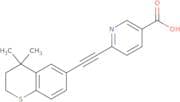
CAS:Formula:C19H17NO2SPurity:97%Color and Shape:SolidMolecular weight:323.4088Tazarotenic acid
CAS:Tazarotenic acid (AGN-190299) is a retinoid prodrug which is converted to its active formFormula:C19H17NO2SPurity:97.83%Color and Shape:SolidMolecular weight:323.41Tazarotenic Acid-d8
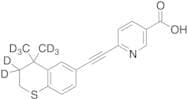
CAS:Controlled ProductApplications Labelled Tazarotenic Acid (T010060). Tazarotenic acid is the major active metabolite of Tazarotene (T010050).
References Nagpal, S., et al.: J. Biol. Chem., 270, 923 (1995), Madhu, C., et al.: J. Pharm. Sci., 86, 972 (1997), Attar, M., et al.: Drug Metab. Dispos., 31, 476 (2003),Formula:C19H9D8NO2SColor and Shape:Light Yellow To BeigeMolecular weight:331.46Tazarotenic Acid
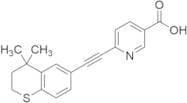
CAS:Controlled ProductApplications Tazarotenic acid is the major active metabolite of Tazarotene (T010050).
References Nagpal, S., et al.: J. Biol. Chem., 270, 923 (1995), Madhu, C., et al.: J. Pharm. Sci., 86, 972 (1997), Attar, M., et al.: Drug Metab. Dispos., 31, 476 (2003),Formula:C19H17NO2SColor and Shape:NeatMolecular weight:323.41Tazarotenic acid
CAS:Tazarotene is a synthetic retinoid that has been used for the treatment of psoriasis, acne and skin cancer. Tazarotene is a prodrug that is converted to active metabolites in the skin. In vitro assays using human sclera have shown that tazarotene has high receptor activity and can inhibit the synthesis of collagenase, which leads to an increase in dermal thickness. Tazarotene also has been shown to induce hepatic steatosis and toxicity studies have shown liver enzyme elevation, as well as increased serum levels of triglycerides and cholesterol. Tazarotene can cause skin irritation or dryness due to its low pH level, although the risk of localized irritation increases with higher concentrations or application time. The effects on skin are reversible upon discontinuation of use.Formula:C19H17NO2SPurity:Min. 98 Area-%Color and Shape:PowderMolecular weight:323.41 g/mol
![3-Pyridinecarboxylicacid, 6-[2-(3,4-dihydro-4,4-dimethyl-2H-1-benzothiopyran-6-yl)ethynyl]-](/_next/image/?url=https%3A%2Fstatic.cymitquimica.com%2Fproducts%2FIN%2Fthumb%2FDA007QG4.jpg&w=3840&q=75)