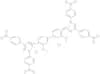
CAS 1184-43-6
:Tetranitro Blue Tetrazolium
Description:
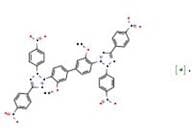
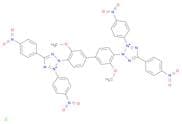
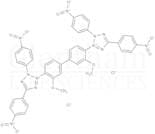
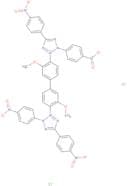
Tetranitro Blue Tetrazolium (TNBT) is a chemical compound commonly used as a redox indicator and in various biochemical assays. It is characterized by its vibrant blue color, which results from its reduction to formazan derivatives when it interacts with reducing agents. TNBT is a tetrazolium salt, and its structure includes four nitro groups attached to a tetrazolium ring, contributing to its stability and solubility in polar solvents. The compound is often employed in microbiological studies to assess cell viability, as living cells can reduce TNBT, leading to a color change that indicates metabolic activity. Additionally, TNBT is utilized in histological staining and as a component in various laboratory protocols, including those related to enzyme activity and oxidative stress. Safety considerations should be taken into account when handling TNBT, as it may pose health risks if ingested or inhaled. Overall, TNBT serves as a valuable tool in both research and clinical settings due to its distinctive properties and applications in detecting biological activity.
Formula:C40H28N12O10·2Cl
InChI:InChI=1S/C40H28N12O10.2ClH/c1-61-37-23-27(7-21-35(37)47-43-39(25-3-9-31(10-4-25)49(53)54)41-45(47)29-13-17-33(18-14-29)51(57)58)28-8-22-36(38(24-28)62-2)48-44-40(26-5-11-32(12-6-26)50(55)56)42-46(48)30-15-19-34(20-16-30)52(59)60;;/h3-24H,1-2H3;2*1H/q+2;;/p-2
InChI key:InChIKey=VCESGVLABVSDRO-UHFFFAOYSA-L
SMILES:O(C)C1=C(N2[N+](=NC(=N2)C3=CC=C(N(=O)=O)C=C3)C4=CC=C(N(=O)=O)C=C4)C=CC(=C1)C5=CC(OC)=C(C=C5)N6[N+](=NC(=N6)C7=CC=C(N(=O)=O)C=C7)C8=CC=C(N(=O)=O)C=C8.[Cl-]
Synonyms:- 2,2′,5,5′-Tetra-p-nitrophenyl-3,3′-(3,3′-dimethoxy-4,4′-biphenylene)ditetrazolium chloride
- 2,2′,5,5′-Tetrakis(p-nitrophenyl)-3,3′-(3,3′-dimethoxy-4,4′-diphenylene)ditetrazolium chloride
- 2,2′,5,5′-Tetrakis-p-(nitrophenyl)-3,3′-bis(3,3′-dimethoxy-4,4′-diphenylene)ditetrazolium chloride
- 2H-Tetrazolium, 2,2'-(3,3'-dimethoxy(1,1'-biphenyl)-4,4'-diyl)bis(3,5-bis(4-nitrophenyl)-, chloride (1:2)
- 2H-Tetrazolium, 2,2'-(3,3'-dimethoxy(1,1'-biphenyl)-4,4'-diyl)bis(3,5-bis(4-nitrophenyl)-, dichloride
- 2H-Tetrazolium, 3,3′-(3,3′-dimethoxy-4,4′-biphenylylene)bis[2,5-bis(p-nitrophenyl)-, dichloride
- 3,3'-(3,3'-Dimethoxy(1,1'-biphenyl)-4,4'-diyl)bis(2,5-bis(p-nitrophenyl)-2H-tetrazolium) dichloride
- 3,3'-(3,3'-dimethoxybiphenyl-4,4'-diyl)bis[2,5-bis(4-nitrophenyl)-2H-tetrazol-3-ium]
- 3,3'-(3,3'-dimethoxybiphenyl-4,4'-diyl)bis[2,5-bis(4-nitrophenyl)-2H-tetrazol-3-ium] dichloride
- Blue p-nitrotetrazolium chloride
- Nitroblue monotetrazolium chloride
- Nsc 121208
- Tetranitro Blue Tetrazolium
- Tetranitro Blue tetrazolium chloride hydrate
- Tetranitro-BT
- Tetranitroblue tetrazolium chloride
- Tetranitrotetrazolium blue
- Tnbt
- See more synonyms
Sort by
Purity (%)
0
100
|
0
|
50
|
90
|
95
|
100
Found 5 products.
Tetranitro blue tetrazolium chloride, 97%
CAS:Redox indicator for enzymesFormula:C40H28Cl2N12O10Purity:97%Color and Shape:Yellow, Powder or crystals or crystalline powderMolecular weight:907.64Tetranitroblue tetrazolium chloride
CAS:Formula:C40H28Cl2N12O10Purity:96%Color and Shape:SolidMolecular weight:907.6307Tetranitroblue tetrazolium chloride
CAS:Formula:C40H28Cl2N12O10·2C2H6OPurity:(HPLC) ≥ 96.0%Color and Shape:Yellow crystalline powderMolecular weight:999.78Tetranitroblue tetrazolium chloride
CAS:Tetranitroblue tetrazolium chloride (TNBT) is a reagent that is used to measure the activity of enzymes in biological samples. TNBT can be used as a histological stain for myocardial infarcts and other areas of necrosis. It has been shown to be reactive with toll-like receptors, which are proteins that play a role in the immune response. The reaction mechanism of TNBT starts with its conversion to blue formazan crystals by peroxidase or other oxidizing enzymes. These crystals are reduced back to their original colorless form by reducing agents such as NADH or glutathione, which are present in most cells. This reduction process generates an electron that is then transferred to NAD+, forming NADH and releasing H2O2 as a byproduct.
Formula:C40H28Cl2N12O10Purity:Min. 95%Color and Shape:PowderMolecular weight:907.63 g/mol