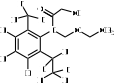
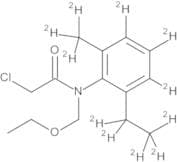
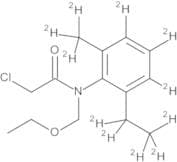
CAS 1189897-44-6
:ACETOCHLOR D11
Description:
Acetochlor D11, with the CAS number 1189897-44-6, is a selective herbicide primarily used in agriculture for the control of annual grasses and certain broadleaf weeds in crops such as corn and soybeans. It belongs to the chloroacetanilide class of herbicides, which function by inhibiting the synthesis of fatty acids in plants, ultimately disrupting their growth. Acetochlor D11 is characterized by its relatively low volatility and persistence in soil, which allows for effective weed control over an extended period. It is typically applied pre-emergence or early post-emergence, ensuring that it targets weeds before they establish. The substance is generally considered to have low toxicity to mammals, but it can pose risks to aquatic organisms, necessitating careful management and application practices to minimize environmental impact. As with many agricultural chemicals, adherence to safety guidelines and regulations is crucial to mitigate potential risks associated with its use.
Formula:C14H9ClD11NO2
Synonyms:- Acetochlor-(2-ethyl-6-methylphenyl-d11)
- ACETOCHLOR D11
- 2-Chloro-N-(ethoxy-methyl)-N-(2-ethyl-6-methylphenyl-d11)acetamid
- 2-Chloro-N-(ethoxy-methyl)-N-(2-ethyl-6-methylphenyl-d11)acetamide
- 2'-Ethyl-6'-Methyl-N-(ethoxyMethyl)-2-chloroacetanilide-d11
- ACETOCHLOR-D11 (2-ETHYL-6-METHYLPHENYL-D11)
Sort by
Purity (%)
0
100
|
0
|
50
|
90
|
95
|
100
Found 4 products.
Acetochlor-d11 (2-ethyl-6-methylphenyl-d11)
CAS:Purity:98 atom % DColor and Shape:Colorless-Brown LiquidMolecular weight:280.84Acetochlor D11 100 µg/mL in Acetone
CAS:Controlled ProductFormula:C14H11H9ClNO2Color and Shape:Single SolutionMolecular weight:280.83Acetochlor-d11
CAS:Controlled ProductApplications Isotope labelled Acetochlor (A162500), which is a chloroacetanilides related herbicide that inhibits elongase and geranylgeranyl pyrophosphate (GGPP) cyclization enzymes (1,2). Drinking water contaminant candidate list 3 (CCL 3) compound as per United States Environmental Protection Agency (EPA), environmental, and food contaminants.
Not a dangerous good if item is equal to or less than 1g/ml and there is less than 100g/ml in the package
References 1. Duchowicz, P., et al.: Bioorg. Med. Chem., 16, 7944 (2008) 2. Arregui, M. C., et al.: Pest Manag Sci. 66, 736 (2010)Formula:C142H11H9ClNO2Color and Shape:YellowMolecular weight:280.83