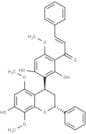
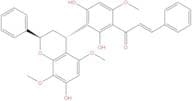
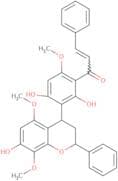
![2-Propen-1-one,1-[3-[(2R,4R)-3,4-dihydro-7-hydroxy-5,8-dimethoxy-2-phenyl-2H-1-benzopyran-4-yl]-2,…](/_next/image/?url=https%3A%2Fstatic.cymitquimica.com%2Fcas-image%2Fthumb-webp%2F395666-2-propen-1-one-1-3-2r-4r-34-dihydro-7-hydroxy-58-dimethoxy-2-phenyl-2h-1-benzopyran-4-yl-24-dihydroxy-6-methoxyphenyl-3-phenyl-2e.webp&w=3840&q=75)
CAS 1190225-47-8
:2-Propen-1-one,1-[3-[(2R,4R)-3,4-dihydro-7-hydroxy-5,8-dimethoxy-2-phenyl-2H-1-benzopyran-4-yl]-2,4-dihydroxy-6-methoxyphenyl]-3-phenyl-,(2E)-
Description:
The chemical substance known as "2-Propen-1-one, 1-[3-[(2R,4R)-3,4-dihydro-7-hydroxy-5,8-dimethoxy-2-phenyl-2H-1-benzopyran-4-yl]-2,4-dihydroxy-6-methoxyphenyl]-3-phenyl-, (2E)-" with CAS number 1190225-47-8 is a complex organic compound characterized by its structure, which includes multiple functional groups such as phenolic hydroxyls and methoxy groups. This compound is likely to exhibit significant biological activity due to its polyphenolic nature, which is often associated with antioxidant properties. The presence of the benzopyran moiety suggests potential applications in medicinal chemistry, particularly in the development of therapeutic agents. Additionally, the compound's E configuration indicates a specific geometric arrangement around the double bond, which can influence its reactivity and interaction with biological targets. Overall, this substance represents a class of compounds that may have implications in pharmacology and biochemistry, warranting further investigation into its properties and potential uses.
Formula:C33H30O8
Synonyms:- SarcandroneA
Sort by
Purity (%)
0
100
|
0
|
50
|
90
|
95
|
100
Found 3 products.
Sarcandrone A
CAS:Sarcandrone A is a natural product for research related to life sciences. The catalog number is TN4947 and the CAS number is 1190225-47-8.Formula:C33H30O8Purity:98%Color and Shape:SolidMolecular weight:554.59Sarcandrone A
CAS:Formula:C33H30O8Purity:95%~99%Color and Shape:Yellow powderMolecular weight:554.595Sarcandrone A
CAS:Sarcandrone A is a bioactive compound, which is derived from the plant Sarcandra glabra, a member of the Chloranthaceae family. This plant is native to tropical and subtropical regions, where it has been traditionally used in various medicinal practices. The mode of action of Sarcandrone A involves the modulation of cellular pathways that are critical for the regulation of apoptosis and cell proliferation. Specifically, it interacts with molecular targets involved in the induction of apoptotic pathways in malignant cells while sparing normal cells.Formula:C33H30O8Purity:Min. 95%Molecular weight:554.6 g/mol