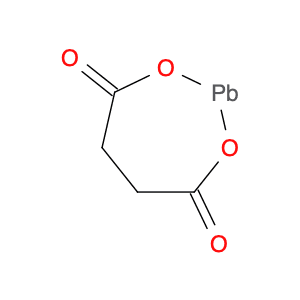
CAS 1191-18-0
:Butanedioic acid, lead(2+) salt (1:1)
Description:
Butanedioic acid, lead(2+) salt (1:1), commonly known as lead succinate, is an inorganic compound formed from the reaction of lead(II) ions with butanedioic acid (succinic acid). This compound typically appears as a white or off-white solid and is characterized by its relatively low solubility in water, which is a common trait of many lead salts. Lead succinate is primarily used in various industrial applications, including as a stabilizer in plastics and as a pigment in paints. However, due to the toxicity of lead and its potential environmental and health hazards, its use is heavily regulated. The compound exhibits typical properties of lead salts, such as thermal stability and the ability to form complexes with other ligands. Safety precautions are essential when handling this substance, as lead exposure can lead to serious health issues, including neurological damage. Proper disposal methods and adherence to safety guidelines are crucial to mitigate risks associated with lead compounds.
Formula:C4H4O4Pb
InChI:InChI=1S/C4H6O4.Pb/c5-3(6)1-2-4(7)8;/h1-2H2,(H,5,6)(H,7,8);/q;+2/p-2
InChI key:InChIKey=CEYLPYBDQDCTPB-UHFFFAOYSA-L
SMILES:O=C1CCC(=O)O[Pb]O1
Synonyms:- Butanedioic acid, lead(2+) salt (1:1)
- Lead(II) succinate
- Succinic acid, lead(2+) salt (1:1)
Sort by
The purity filter is not visible because current products do not have associated purity data for filtering.
Found 1 products.