CAS 1192-33-2
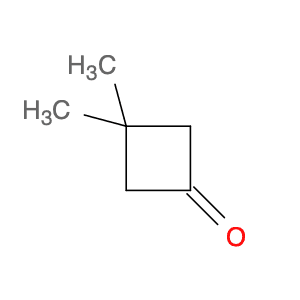
:3,3-dimethylcyclobutanone
Description:
3,3-Dimethylcyclobutanone is a cyclic ketone characterized by its four-membered cyclobutane ring with two methyl groups attached to the same carbon atom, specifically at the 3-position. This structural arrangement contributes to its unique chemical properties, including its reactivity and stability. The presence of the carbonyl group (C=O) in the cyclobutane framework makes it a ketone, which can participate in various chemical reactions such as nucleophilic additions. The compound is typically a colorless liquid at room temperature and has a distinctive odor. Its molecular formula reflects its composition of carbon, hydrogen, and oxygen, and it exhibits moderate polarity due to the carbonyl functional group. 3,3-Dimethylcyclobutanone is of interest in organic synthesis and may serve as an intermediate in the production of more complex molecules. Additionally, its physical properties, such as boiling point and solubility, are influenced by the steric effects of the methyl groups and the ring strain inherent in the cyclobutane structure.
Formula:C6H10O
InChI:InChI=1/C6H10O/c1-6(2)3-5(7)4-6/h3-4H2,1-2H3
SMILES:CC1(C)CC(=O)C1
Synonyms:- Cyclobutanone, 3,3-Dimethyl-
Sort by
Purity (%)
0
100
|
0
|
50
|
90
|
95
|
100
Found 4 products.
Cyclobutanone, 3,3-dimethyl-
CAS:Formula:C6H10OPurity:95%Color and Shape:LiquidMolecular weight:98.14303,3-Dimethylcyclobutan-1-one
CAS:3,3-Dimethylcyclobutan-1-one is a molecule that has been shown to be a sensitizer of ethylene in the presence of activated oxygen. The kinetics of this reaction were studied by determining the rate constant for the formation of 3,3-dimethylcyclobutan-1-one at various temperatures. This compound is an analog to cyclobutanone and can be synthesized by photolytic or reductive elimination. The nature of the substituents on the ring affects the bond cleavage and product yields during these reactions. 3,3-Dimethylcyclobutan-1-one has been used as a radiation sensitizer for polymers, although this application is limited because it reacts with oxygen. In addition, 3,3-dimethylcyclobutan-1-one can be used to produce isobutene by coupling with acetylene.Formula:C6H10OPurity:Min. 95%Molecular weight:98.14 g/mol