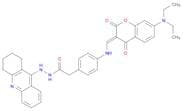
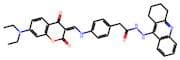
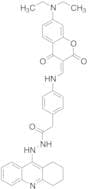
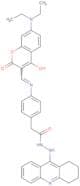
CAS 1192750-33-6
:PE 154
- Benzeneacetic acid, 4-[[[7-(diethylamino)-2,4-dioxo-2H-1-benzopyran-3(4H)-ylidene]methyl]amino]-, 2-(1,2,3,4-tetrahydro-9-acridinyl)hydrazide
- PE 154
- 2-(1,2,3,4-Tetrahydro-9-acridinyl)hydrazide-4-[[[7-(diethylamino)-2,4-dioxo-2H-1-benzopyran-3(4H)-ylidene]methyl]amino]-benzeneacetic acid
- (E)-2-(4-(((7-(Diethylamino)-2,4-dioxochroman-3-ylidene)methyl)amino)phenyl)-N'-(1,2,3,4-tetrahydroacridin-9-yl)acetohydrazide
- 4-[[[7-(Diethylamino)-2,4-dioxo-2H-1-benzopyran-3(4H)-ylidene]methyl]amino]-benzeneacetic acid 2-(1,2,3,4-tetrahydro-9-acridinyl)hydrazide
PE 154
CAS:PE 154: fluorescent, inhibits AChE/BChE (IC50: 280 pM/16 nM), labels β-amyloid plaques.Formula:C35H35N5O4Purity:99.83%Color and Shape:SolidMolecular weight:589.68PE 154
CAS:PE 154 is a nucleotide analog that inhibits the transcription-polymerase chain reaction. It is most commonly used in the detection of viruses because it inhibits viral growth by preventing RNA synthesis. PE 154 also has antireflection properties that allow for better light transmission, making it useful for optical devices. In addition to its antiviral activity, PE 154 has been shown to inhibit the replication of human herpes virus 6 and 7, as well as other viruses such as HIV-1, HIV-2, and cytomegalovirus.
br>
PE 154 binds to DNA and prevents the initiation of transcription by blocking polymerase binding sites on the DNA template strand. This leads to a decrease in gene expression and protein synthesis, which can lead to cell death. PE 154 also blocks reverse transcriptase activity by binding to primer binding sites on the single-stranded DNA template strand. This leads to an inhibition of RNA synthesis and subsequent protein synthesis.br>br>
The drugFormula:C35H35N5O4Purity:Min. 95%Molecular weight:589.68 g/molRef: 3D-SXB75033
Discontinued product