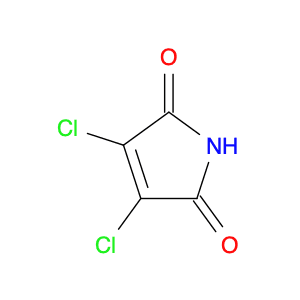
CAS 1193-54-0
:3,4-Dichloro-1H-pyrrole-2,5-dione
Description:
3,4-Dichloro-1H-pyrrole-2,5-dione, with the CAS number 1193-54-0, is a synthetic organic compound characterized by its pyrrole ring structure, which is a five-membered aromatic heterocycle containing nitrogen. This compound features two chlorine substituents at the 3 and 4 positions and two carbonyl groups at the 2 and 5 positions of the pyrrole ring, contributing to its reactivity and potential applications in various chemical processes. It is typically a solid at room temperature and may exhibit a range of colors depending on its purity and form. The presence of chlorine atoms enhances its electrophilic character, making it useful in organic synthesis, particularly in the development of pharmaceuticals and agrochemicals. Additionally, the compound may exhibit biological activity, although specific interactions and mechanisms would require further investigation. Safety data should be consulted, as halogenated compounds can pose environmental and health risks. Overall, 3,4-Dichloro-1H-pyrrole-2,5-dione is a notable compound in the field of organic chemistry with diverse applications.
Formula:C4HCl2NO2
InChI:InChI=1S/C4HCl2NO2/c5-1-2(6)4(9)7-3(1)8/h(H,7,8,9)
InChI key:InChIKey=KVBAKSQRUXXHCK-UHFFFAOYSA-N
SMILES:ClC1=C(Cl)C(=O)NC1=O
Synonyms:- 1H-Pyrrole-2,5-dione, 3,4-dichloro-
- 3,4-Dichloro-1H-Pyrrole-2,5-Dione
- 3,4-Dichloro-2,5-dihydro-1H-pyrrole-2,5-dione
- 3,4-Dichloromaleimide
- 3,4-Dichloropyrrole-2,5-dione
- Dichloromaleinimide
- Maleimide, 2,3-dichloro-
Sort by
Purity (%)
0
100
|
0
|
50
|
90
|
95
|
100
Found 4 products.
3,4-DICHLOROMALEINIMIDE
CAS:Formula:C4HCl2NO2Purity:95%Color and Shape:SolidMolecular weight:165.96223,4-Dichloro-1H-pyrrole-2,5-dione
CAS:3,4-Dichloro-1H-pyrrole-2,5-dionePurity:98%Molecular weight:165.96g/mol3,4-dichloro-2,5-dihydro-1H-pyrrole-2,5-dione
CAS:3,4-dichloro-2,5-dihydro-1H-pyrrole-2,5-dione is a compound that has been used in the synthesis of conjugates. It has been shown to be an inhibitor of mitochondrial protein synthesis and is able to inhibit the growth of Candida glabrata and Trichophyton mentagrophytes at concentrations of 2.0 mM. The compound is also reversible and can be hydrolyzed by hydrochloric acid. 3,4-Dichloro-2,5-dihydro-1H-pyrrole-2,5-dione shows synergistic effects with hepg2 cells and human liver cancer cells when combined with chlorine atom. This compound has been shown to have a high affinity for polycarbonates as well as a low molecular weight (270).Formula:C4HCl2NO2Purity:Min. 95%Molecular weight:165.96 g/mol