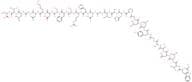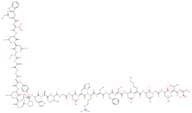
CAS 119418-04-1
:galanin human
Description:
Galanin is a neuropeptide that plays a significant role in various physiological processes, including the regulation of mood, appetite, and pain perception. The human form of galanin, identified by the CAS number 119418-04-1, is composed of a sequence of amino acids that allows it to interact with specific galanin receptors in the body. This interaction is crucial for mediating its effects on neurotransmission and hormonal regulation. Galanin is primarily expressed in the central nervous system and peripheral tissues, influencing functions such as neuroprotection, neurogenesis, and modulation of stress responses. It is also involved in the regulation of circadian rhythms and has been implicated in various pathological conditions, including depression and obesity. The peptide is characterized by its relatively small size and structural flexibility, which contribute to its ability to bind to multiple receptor subtypes. Overall, galanin serves as an important signaling molecule with diverse biological functions, making it a subject of interest in both basic and clinical research.
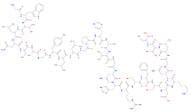
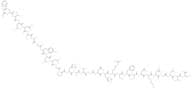
Formula:C139H210N42O43
Synonyms:- H-Gly-Trp-Thr-Leu-Asn-Ser-Ala-Gly-Tyr-Leu-Leu-Gly-Pro-His-Ala-Val-Gly-Asn-His-Arg-Ser-Phe-Ser-Asp-Lys-Asn-Gly-Leu-Thr-Ser-OH
Sort by
Purity (%)
0
100
|
0
|
50
|
90
|
95
|
100
Found 6 products.
Galanin (human)
CAS:Human galanin, a 30-amino acid non-amidated peptide, has originally been isolated from colon and pituitary. Its sequence differs from that of rat and porcine galanins by 4 and 6 amino acids in the C-terminal moiety, respectively. Synthetic human galanin is equipotent to the rat peptide in the isolated rat fundus muscle strip bioassay. Both peptides also fully activate the rat galanin receptor, indicating the importance of the conserved N-terminal portion of galanin for receptor interaction. Galanin, which is widely distributed in the CNS, and GAL receptors (GALR) are overexpressed in limbic brain regions associated with cognition in Alzheimer disease. As galanin inhibits acetylcholine release, galanin antagonists have gained interest in AD research.Formula:C139H210N42O43Purity:96.2%Color and Shape:White PowderMolecular weight:3157.45Galanin (human)
CAS:Galanin has been shown to inhibit acetylcholine release, glutamate release and carbachol-stimulated phosphatidylinositol hydrolysis in the hippocampus. The peptide hormone is also linked to behavioral and cognitive deficits in Alzheimer’s disease.Formula:C139H210N42O43Purity:98.2%Color and Shape:WhiteMolecular weight:3157.45Galanin (1-30), human
CAS:Galanin (1-30), human is a neuropeptide agonist for GalR1/R2 receptors with 1 nM affinity, influencing endocrine, metabolism, and neurotransmission.Formula:C139H210N42O43Purity:98%Color and Shape:SolidMolecular weight:3157.46Galanin (Human)
CAS:Galanin is a peptide that belongs to the family of neuropeptides and is found in the endocrine system, the central and peripheral nervous systems. It has been shown to inhibit the release of acetylcholine in the central nervous system and interestingly in Alzheimer’s disease patients, hyperinervation of galanin fibres has been found. Galanin is also known to have a variety of physiological effects including inhibition of insulin release, stimulation of prolactin and growth hormone secretion and it also plays a role in feeding, mood, cognition, neuroendocrine regulation and affects gastrointestinal motility. Galanin asserts its effects through associated with G-protein coupled receptors. This product is available as a 0.5mg vial.
Formula:C139H210N42O43Purity:Min. 95%Molecular weight:3,157.4 g/molGalanin (human) trifluoroacetate salt
CAS:Please enquire for more information about Galanin (human) trifluoroacetate salt including the price, delivery time and more detailed product information at the technical inquiry form on this pageFormula:C139H210N42O43Purity:Min. 95%Molecular weight:3,157.41 g/mol