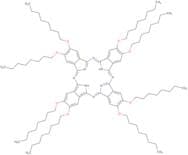
CAS 119457-81-7
:2,3,9,10,16,17,23,24-octakis(octyloxy)-29H,31H-ph
Description:
The chemical substance known as "2,3,9,10,16,17,23,24-octakis(octyloxy)-29H,31H-ph" is a complex organic compound characterized by its multiple octyloxy substituents. This structure suggests a high degree of hydrophobicity due to the long alkyl chains, which can influence its solubility and interaction with other substances. The presence of multiple ether linkages (octyloxy groups) typically enhances the compound's stability and may impart unique physical properties, such as lower melting and boiling points compared to similar compounds with fewer alkyl chains. Additionally, the compound's large molecular size and branched structure can lead to interesting behavior in various applications, including potential uses in materials science, nanotechnology, or as surfactants. Its specific properties, such as thermal stability, reactivity, and potential applications, would depend on the overall molecular architecture and the arrangement of the octyloxy groups. Further characterization through techniques like NMR, IR spectroscopy, or mass spectrometry would provide more detailed insights into its properties and behavior.
- 2,3,9,10,16,17,23,24-Octakis(octyloxy)-29H,31H-phthalocyanine
Sort by
Purity (%)
0
100
|
0
|
50
|
90
|
95
|
100
Found 2 products.
29H,31H-Phthalocyanine, 2,3,9,10,16,17,23,24-octakis(octyloxy)-
CAS:Formula:C96H146N8O8Molecular weight:1540.23522,3,9,10,16,17,23,24-Octakis(octyloxy)-29H,31H-phthalocyanine
CAS:<p>2,3,9,10,16,17,23,24-Octakis(octyloxy)-29H,31H-phthalocyanine (OCTPt) is a silicon-based molecule that has been shown to be an effective inhibitor of metal ion catalyzed oxidation. The molecule is not spontaneous and requires nanomolar concentrations in order to inhibit the reaction. The molecule is able to inhibit the oxidation of metal surfaces at efficiencies up to 99%. OCTPt binds to the metal surface and prevents oxygen from binding. This leads to a decrease in the rate of oxidation by about two orders of magnitude. A Langmuir adsorption isotherm was used to study the thermodynamic properties of OCTPt on gold surfaces. OCTPt was shown to have a strong synergistic effect with other inhibitors such as 2-mercaptobenzothiazole (MBTZ). The molecules can be seen using microscopy techniques such as scanning electron microscopy</p>Formula:C96H146N8O8Purity:Min. 95%Molecular weight:1,540.24 g/mol