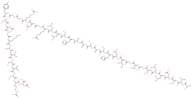
CAS 119938-54-4
:L-Asparagine,L-alanyl-L-threonyl-L-cysteinyl-L-a-aspartyl-L-leucyl-L-leucyl-L-serylglycyl-L-threonylglycyl-L-isoleucyl-L-asparaginyl-L-histidyl-L-seryl-L-alanyl-L-cysteinyl-L-alanyl-L-alanyl-L-histidyl-L-cysteinyl-L-leucyl-L-leucyl-L-arginylglycyl-L-aspar
Description:
The chemical substance with the name "L-Asparagine, L-alanyl-L-threonyl-L-cysteinyl-L-a-aspartyl-L-leucyl-L-leucyl-L-serylglycyl-L-threonylglycyl-L-isoleucyl-L-asparaginyl-L-histidyl-L-seryl-L-alanyl-L-cysteinyl-L-alanyl-L-alanyl-L-histidyl-L-cysteinyl-L-leucyl-L-leucyl-L-arginylglycyl-L-aspar" and CAS number "119938-54-4" is a complex peptide composed of various amino acids. This substance is characterized by its high molecular weight and specific sequence of amino acids, which contribute to its unique properties and potential biological functions. Peptides like this one can exhibit a range of activities, including roles in signaling, enzyme catalysis, and structural functions within biological systems. The presence of multiple amino acids, including asparagine, alanine, threonine, cysteine, leucine, serine, isoleucine, histidine, and arginine, suggests that it may have diverse interactions with other biomolecules. Additionally, the sequence and composition can influence its solubility, stability, and reactivity, making it of interest in fields such as biochemistry, pharmacology, and biotechnology.
Formula:C164H266N58O52S6
Synonyms:- Sapecin(9CI)
Sort by
Purity (%)
0
100
|
0
|
50
|
90
|
95
|
100
Found 2 products.
L-Asparagine, L-alanyl-L-threonyl-L-cysteinyl-L-α-aspartyl-L-leucyl-L-leucyl-L-serylglycyl-L-threonylglycyl-L-isoleucyl-L-asparaginyl-L-histidyl-L-seryl-L-alanyl-L-cysteinyl-L-alanyl-L-alanyl-L-histidyl-L-cysteinyl-L-leucyl-L-leucyl-L-arginylglycyl-L-asparaginyl-L-arginylglycylglycyl-L-tyrosyl-L-cysteinyl-L-asparaginylglycyl-L-lysyl-L-alanyl-L-valyl-L-cysteinyl-L-valyl-L-cysteinyl-L-arginyl-, cyclic (3→30),(16→36),(20→38)-tris(disulfide)
CAS:Formula:C164H272N58O52S6Molecular weight:4080.6619Sapecin
CAS:Sapecin is an antimicrobial peptide, which is derived from the hemolymph of the silk moth (Bombyx mori) with potent bactericidal action. The source of Sapecin is the immune system of the silk moth, where it acts as a natural defense mechanism against microbial infections. Its mode of action involves disrupting bacterial cell membranes, leading to cell lysis and death. The peptide achieves this by inserting itself into the lipid bilayer, creating pores that compromise the structural integrity of the membrane.Formula:C164H266N58O52S6Purity:Min. 95%Molecular weight:4,074.62 g/mol