CAS 1199943-44-6
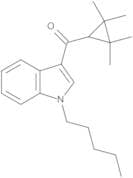
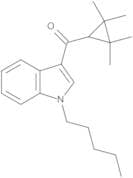
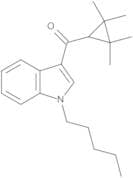
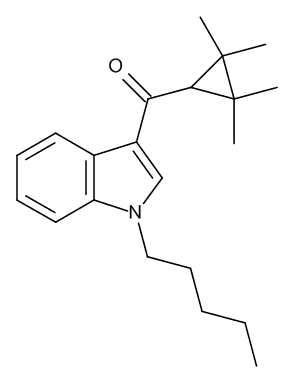
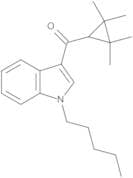
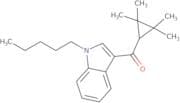
:(1-Pentyl-1H-indol-3-yl)(2,2,3,3-tetramethylcyclopropyl)methanone
Description:
(1-Pentyl-1H-indol-3-yl)(2,2,3,3-tetramethylcyclopropyl)methanone, identified by its CAS number 1199943-44-6, is a synthetic compound that belongs to the class of indole derivatives. This substance is characterized by its complex molecular structure, which includes an indole moiety linked to a cyclopropyl group. The presence of the pentyl chain contributes to its hydrophobic properties, while the tetramethylcyclopropyl component adds steric bulk, influencing its interaction with biological targets. This compound has garnered attention in research contexts, particularly in studies related to cannabinoid receptors, due to its potential psychoactive effects. Its solubility and stability can vary based on environmental conditions, and it may exhibit unique pharmacological properties. As with many synthetic cannabinoids, understanding its safety profile, including toxicity and potential for abuse, is crucial for evaluating its implications in both therapeutic and recreational contexts. Proper handling and regulatory compliance are essential when working with such substances in laboratory settings.
Formula:C21H29NO
InChI:InChI=1S/C21H29NO/c1-6-7-10-13-22-14-16(15-11-8-9-12-17(15)22)18(23)19-20(2,3)21(19,4)5/h8-9,11-12,14,19H,6-7,10,13H2,1-5H3
InChI key:InChIKey=NBMMIBNZVQFQEO-UHFFFAOYSA-N
SMILES:C(=O)(C1C(C)(C)C1(C)C)C=2C=3C(N(CCCCC)C2)=CC=CC3
Synonyms:- (1-Pentyl-1H-Indol-3-Yl)(2,2,3,3-Tetramethylcyclopropyl)Methanone
- Methanone, (1-pentyl-1H-indol-3-yl)(2,2,3,3-tetramethylcyclopropyl)-
- Methanone, (1- pentyl- 1H- indol- 3- yl) (2, 2, 3, 3- tetramethylcycloprop yl)
- Ur-144
Sort by
Purity (%)
0
100
|
0
|
50
|
90
|
95
|
100
Found 9 products.
UR-144 ((1-Pentylindol-3-yl)(2,2,3,3-tetramethylcyclopropyl)methanone; KM X-1)
CAS:Controlled ProductColor and Shape:NeatUR-144 ((1-Pentylindol-3-yl)(2,2,3,3-tetramethyl-cyclopropyl)methanone; KM X-1) 0.1 mg/ml in Acetonitrile
CAS:Controlled ProductColor and Shape:Single SolutionUR-144 ((1-Pentylindol-3-yl)(2,2,3,3-tetramethylcyclopropyl)methanone; KM X-1) 1.0 mg/ml in Acetonitrile
CAS:Controlled ProductColor and Shape:Single Solution(1-Pentyl-1H-indol-3-yl)(2,2,3,3-tetramethylcyclopropyl)methanone (UR-144)
CAS:Controlled Product<p>Applications (1-Pentyl-1H-indol-3-yl)(2,2,3,3-tetramethylcyclopropyl)methanone is an Indol-3-ylcycloalkyl Ketone with high affinity for the CB2 cannabinoid receptor. Tetramethylcyclopropyl group was found to lead to high affinity CB2 agonists. Synthetic Cannabinoids<br>References Malan, T., et al.: Curr. Opin. Pharmacol., 3, 62 (2003), Cabral, G., et al.: J. Leukocyte Biol., 78, 1192 (2005), Beltramo, M., et al.: Eur. J. Neurosci., 23, 1530 (2006), Dziadulewicz, E., et al.: J. Med. Chem., 50, 3851 (2007),<br></p>Formula:C21H29NOColor and Shape:White To Off-WhiteMolecular weight:311.46(1-Pentyl-1H-indol-3-yl)(2,2,3,3-tetramethylcyclopropyl)methanone (UR-144) (1.0 mg/mL in Methanol)
CAS:Controlled ProductFormula:C21H29NOColor and Shape:Single SolutionMolecular weight:311.46UR 144
CAS:Controlled ProductUR-144 is a weak synthetic cannabinoid that binds as a selective full agonist to the peripheral cannabinoid receptor CB2 (EC50 = 72 nM). It also binds to CB1 (EC50 = 421 nM) with much lower affinity1. It was recently shown to impair cell proliferation and induce the activation of apoptotic pathways in vitro through different mechanisms as well as causing loss of mitochondrial membrane potential in placental trophoblasts in vitro2. Salmonella/microsome assays revealed induction of DNA damage without gene aberration in lymphocytes3. In vivo mice models showed depression of locomotor activity, catalepsy and hypothermia at a dosage of 10mg/kg, indicating a weak cannabinoid-like activity1.Formula:C21H29NOPurity:Min. 95%Molecular weight:311.46 g/mol