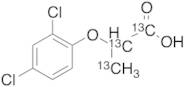
CAS 120-36-5
:Dichlorprop
Description:
Dichlorprop, also known as 2,4-dichlorophenoxypropionic acid, is a selective herbicide primarily used for controlling broadleaf weeds in various crops. It belongs to the phenoxy herbicide family and is characterized by its ability to mimic plant hormones, disrupting normal growth processes in target weeds. The chemical structure features a propionic acid moiety linked to a dichlorophenoxy group, which contributes to its herbicidal activity. Dichlorprop is typically applied in agricultural settings and can be found in formulations that allow for effective weed management. Its mode of action involves the inhibition of cell division and elongation in susceptible plants. While it is effective in controlling weeds, it is essential to handle dichlorprop with care due to potential environmental impacts and toxicity to non-target organisms. Regulatory assessments have established guidelines for its use to minimize risks to human health and the ecosystem. As with any chemical substance, proper application techniques and adherence to safety protocols are crucial to ensure effective and responsible use.
Formula:C9H8Cl2O3
InChI:InChI=1S/C9H8Cl2O3/c1-5(9(12)13)14-8-3-2-6(10)4-7(8)11/h2-5H,1H3,(H,12,13)
InChI key:InChIKey=MZHCENGPTKEIGP-UHFFFAOYSA-N
SMILES:O(C(C(O)=O)C)C1=C(Cl)C=C(Cl)C=C1
Synonyms:- (2,4-Dichlorophenoxy)Acetic Acid
- (2R)-2-(2,4-dichlorophenoxy)propanoate
- (2R)-2-(2,4-dichlorophenoxy)propanoic acid
- (2S)-2-(2,4-dichlorophenoxy)propanoate
- (2S)-2-(2,4-dichlorophenoxy)propanoic acid
- 2,4-Dcppa
- 2,4-Dichlorophenoxy-alpha-Propionic acid
- 2,4-Dichlorophenoxypropionic acid
- 2,4-Dichlorphenoxypropionic Acid
- 2,4-Dichlorprop
- 2,4-Dp
- 2-(2,4-Dichlorophenoxy)Propanoic Acid
- 2-(2,4-Dp)
- Af 302
- Canapur DP
- Celatox DP
- Cornox RK
- DCP
- Dichloroprop
- Dichlorprop
- Dichlorprop acid
- Diclorprop
- Dicopur DP
- Diprop
- Hedonal DP
- Herbizid DP
- Nsc 39624
- Propanoic acid, 2-(2,4-dichlorophenoxy)-
- Propionic acid, 2-(2,4-dichlorophenoxy)-
- U 46DP Fluid
- α-(2,4-Dichlorophenoxy)propionic acid
- See more synonyms
Sort by
Purity (%)
0
100
|
0
|
50
|
90
|
95
|
100
Dichloroprop-13C3
CAS:Applications Dichloroprop-13C3 is the isotope labelled analog of Dichloroprop (D436745), a herbicide used for the postemergence control of annual and perennial broad-leaved weeds and some brush species.
References Freitas, M.R., et al.: RSC Adv., 5, 7547 (2015); Aizawa, H.: Handbook of Metabolic Pathways of Xenobiotics, 3, 1212 (2014)Formula:C3C6H8Cl2O3Color and Shape:NeatMolecular weight:238.042