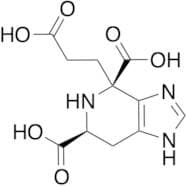
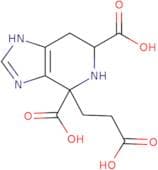
![1H-Imidazo[4,5-c]pyridine-4,6-dicarboxylicacid, 4-(2-carboxyethyl)-4,5,6,7-tetrahydro-, (4R,6S)- (…](/_next/image/?url=https%3A%2Fstatic.cymitquimica.com%2Fcas-image%2Fthumb-webp%2F25219-1h-imidazo-45-c-pyridine-46-dicarboxylicacid-4-2-carboxyethyl-4567-tetrahydro-4r-6s-9ci.webp&w=3840&q=75)
CAS 120293-52-9
:1H-Imidazo[4,5-c]pyridine-4,6-dicarboxylicacid, 4-(2-carboxyethyl)-4,5,6,7-tetrahydro-, (4R,6S)- (9CI)
- 1H-Imidazo[4,5-c]pyridine-4,6-dicarboxylicacid, 4-(2-carboxyethyl)-4,5,6,7-tetrahydro-, (4R-cis)-
- (-)-Mikimopine
(4R,6R)-4-(2-Carboxyethyl)-4,5,6,7-tetrahydro-1H-imidazo[4,5-c]pyridine-4,6-dicarboxylic Acid
CAS:Controlled ProductStability Hygroscopic
Applications (4R,6R)-4-(2-Carboxyethyl)-4,5,6,7-tetrahydro-1H-imidazo[4,5-c]pyridine-4,6-dicarboxylic Acid, is an isomer of Mikimopine (M385508), which forms in roots after transformation with agrobacterium and influences alkaloid production. This in turn affects insect toxicity and allelopathic properties.
References Sauerwein, M. et al.: J. Plant Physiol., 142, 446 (1993);Formula:C11H13N3O6Color and Shape:NeatMolecular weight:283.237Mikimopine
CAS:Controlled ProductStability Hygroscopic, Unstable in Solution
Applications Mikimopine is formed in roots after transformation with agrobacterium and influences alkaloid production. This in turn affects insect toxicity and allelopathic properties.
References Sauerwein, M. et al.: J. Plant Physiol., 142, 446 (1993);Formula:C11H13N3O6Color and Shape:NeatMolecular weight:283.24Mikimopine
CAS:Mikimopine is a kinase inhibitor that has shown promising results in the treatment of cancer. It works by inhibiting specific proteins involved in cancer cell growth and survival, leading to apoptosis (cell death) of tumor cells. Mikimopine is an analog of a naturally occurring protein found in human urine and Chinese medicinal herbs. It specifically targets cyclin-dependent kinases, which are enzymes that regulate cell division and proliferation. This drug has shown potent anticancer activity both in vitro and in vivo, making it a promising candidate for further development as an anticancer agent. Its selectivity towards cancer cells makes it a potentially effective therapy with minimal side effects compared to traditional chemotherapy treatments.
Formula:C11H13N3O6Purity:Min. 95%Molecular weight:283.24 g/mol
![(4R,6R)-4-(2-Carboxyethyl)-4,5,6,7-tetrahydro-1H-imidazo[4,5-c]pyridine-4,6-dicarboxylic Acid](/_next/image/?url=https%3A%2Fstatic.cymitquimica.com%2Fproducts%2FTR%2Fthumb%2FC179210.jpg&w=3840&q=75)