CAS 12036-10-1
:Ruthenium dioxide
Description:
Ruthenium dioxide (RuO2) is a black, crystalline compound of ruthenium, a transition metal. It is known for its high stability and conductivity, making it valuable in various applications, particularly in electronics and catalysis. Ruthenium dioxide exhibits a tetragonal crystal structure and is often found in two forms: the anhydrous form and the hydrated form, which can influence its properties and reactivity. It is insoluble in water and most acids, but can be dissolved in concentrated alkalis. Due to its excellent catalytic properties, RuO2 is widely used in electrochemical applications, such as in fuel cells and as an electrode material in electrolysis. Additionally, it has potential uses in the production of advanced materials and nanostructures. Safety considerations include handling it with care, as it can be a skin and respiratory irritant. Overall, ruthenium dioxide is a significant compound in both industrial and research settings due to its unique chemical and physical properties.
Formula:O2Ru
InChI:InChI=1S/2O.Ru
InChI key:InChIKey=WOCIAKWEIIZHES-UHFFFAOYSA-N
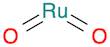
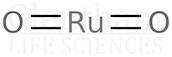
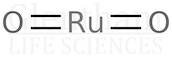
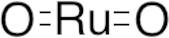
SMILES:[Ru](=O)=O
Synonyms:- Nw 120
- Nw 47
- Nw 54
- Nw 67
- Oxyde de ruthenium (IV)
- Ruthenia
- Ruthenium dioxide
- Ruthenium dioxide (RuO2)
- Ruthenium dioxide (RuO<sub>2</sub>)
- Ruthenium oxide
- Ruthenium oxide (RuO<sub>2</sub>)
- Ruthenium(IV) dioxide
- Ruthenium(IV)oxid
- Ruthenium-Adams catalyst
- oxido de rutenio (IV)
- ruthenium (IV) oxide
- oxygen(2-)
- Ruthenium (IV) Oxide Anhydrous
- ruthenium, dioxo-
- Ruthenium oxide (RuO2)
- ruthenium(4+)
- See more synonyms
Filter by
Purity percentage
0
100
|
0
|
50
|
90
|
95
|
100
Found 9 products.
- Lower prices
- Higher prices
- Lower purities
- Higher purities
- Faster estimated delivery
Ruthenium(IV) oxide, anhydrous, 99.9%
CAS:The most often used oxygen catalyst is ruthenium(IV) oxide. It is applied as an electrochemical super capacitor material, and it has high capacity to store charge. RuO2 is used as catalyst in the Deacon process which produces chlorine through the oxidation of hydrogen chloride. Owing to the high cFormula:O2RuPurity:99.9%Color and Shape:Powder, BlackMolecular weight:133.07Ruthenium(IV) oxide, anhydrous, Premion™, 99.95% (metals basis), Ru 75.2% min
CAS:The most often used oxygen catalyst is ruthenium(IV) oxide. It is applied as an electrochemical super capacitor material, and it has high capacity to store charge. RuO2 is used as catalyst in the Deacon process which produces chlorine through the oxidation of hydrogen chloride. Owing to the high cFormula:O2RuPurity:75.2%Molecular weight:133.07Ruthenium(IV) oxide
CAS:Ruthenium(IV) oxideFormula:·2O·RuPurity:99.95%Color and Shape:Black Solid-PowderMolecular weight:133.0688Ruthenium(IV) oxide, anhydrous (99.9+%-Ru)
CAS:Ruthenium(IV) oxide, anhydrous (99.9+%-Ru)
Formula:RuO2Purity:(99.9+%-Ru)Color and Shape:black pwdr.Molecular weight:133.07Ruthenium(IV) Oxide Anhydrous
CAS:Controlled ProductApplications Ruthenium(IV) Oxide Anhydrous is a research reagent and applied for exfoliation of layered metal oxide nanosheets.
References Lee, J.M., et al.: App. Mat. Interfaces, 11, 12121 (2019)Formula:O2RuColor and Shape:NeatMolecular weight:133.07