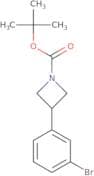
CAS 1203681-54-2
:1,1-Dimethylethyl 3-(3-bromophenyl)-1-azetidinecarboxylate
Description:
1,1-Dimethylethyl 3-(3-bromophenyl)-1-azetidinecarboxylate, identified by its CAS number 1203681-54-2, is a chemical compound characterized by its azetidine ring structure, which is a four-membered saturated heterocyclic compound containing one nitrogen atom. The presence of the 3-(3-bromophenyl) substituent indicates that there is a brominated phenyl group attached to the azetidine ring, contributing to its potential reactivity and biological activity. The dimethyl group at the 1-position of the azetidine enhances steric hindrance, which can influence the compound's interactions with biological targets. This compound may exhibit properties typical of azetidine derivatives, such as potential use in medicinal chemistry or as intermediates in organic synthesis. Its specific characteristics, including solubility, stability, and reactivity, would depend on the functional groups present and the overall molecular structure. As with many organic compounds, safety data and handling precautions should be considered when working with this substance in a laboratory setting.
Formula:C14H18BrNO2
InChI:InChI=1S/C14H18BrNO2/c1-14(2,3)18-13(17)16-8-11(9-16)10-5-4-6-12(15)7-10/h4-7,11H,8-9H2,1-3H3
InChI key:InChIKey=MNQDJKCJNLGVGM-UHFFFAOYSA-N
SMILES:C(OC(C)(C)C)(=O)N1CC(C1)C2=CC(Br)=CC=C2
Synonyms:- 1-Azetidinecarboxylic acid, 3-(3-bromophenyl)-, 1,1-dimethylethyl ester
- 1,1-Dimethylethyl 3-(3-bromophenyl)-1-azetidinecarboxylate
Sort by
Purity (%)
0
100
|
0
|
50
|
90
|
95
|
100
Found 2 products.
1,1-Dimethylethyl 3-(3-bromophenyl)-1-azetidinecarboxylate
CAS:Formula:C14H18BrNO2Purity:95%Color and Shape:LiquidMolecular weight:312.2022tert-Butyl 3-(3-bromophenyl)azetidine-1-carboxylate
CAS:Tert-butyl 3-(3-bromophenyl)azetidine-1-carboxylate (TBAc) is an inhibitor of 3-hydroxyacyl coenzyme A dehydrogenase. It is used as a probe in the study of the structural biology and mechanism of action of this enzyme, which is involved in fatty acid and cholesterol biosynthesis. TBAc has been shown to inhibit the cationic polymerization process, which may indicate its potential use as a cancer therapeutic. The reaction mechanism involves hydrogen bonding and activation energies that are influenced by dihedral angles and p-450 enzymes. TBAc has also been shown to have a strong affinity for trifluoroacetic acid (TFA), which may be due to the formation of an ionic bond between TBAc and TFA.Formula:C14H18BrNO2Purity:Min. 95%Molecular weight:312.2 g/mol