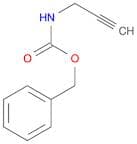
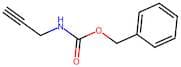
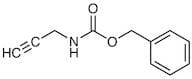
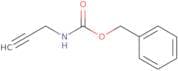
CAS 120539-91-5
:Carbamic acid, 2-propynyl-, phenylmethyl ester
Description:
Carbamic acid, 2-propynyl-, phenylmethyl ester, with the CAS number 120539-91-5, is an organic compound characterized by its ester functional group derived from carbamic acid. This compound features a propynyl group, which is a three-carbon alkyne, contributing to its reactivity and potential applications in organic synthesis. The presence of the phenylmethyl (benzyl) group enhances its lipophilicity, making it more soluble in organic solvents. Typically, carbamic acid esters are known for their roles as intermediates in the synthesis of pharmaceuticals and agrochemicals. They may exhibit biological activity, including potential herbicidal or insecticidal properties, depending on their specific structure and substituents. The stability of this compound can be influenced by factors such as temperature and pH, and it may undergo hydrolysis in the presence of water, reverting to the corresponding carbamic acid and alcohol. Safety data should be consulted for handling and storage, as with all chemical substances, to ensure proper precautions are taken.
Formula:C11H11NO2
Sort by
Purity (%)
0
100
|
0
|
50
|
90
|
95
|
100
Found 6 products.
Benzyl prop-2-yn-1-ylcarbamate
CAS:Formula:C11H11NO2Purity:98%Color and Shape:SolidMolecular weight:189.2105Benzyl prop-2-yn-1-ylcarbamate
CAS:Benzyl prop-2-yn-1-ylcarbamatePurity:98%Molecular weight:189.21g/molN-Carbobenzoxypropargylamine
CAS:Formula:C11H11NO2Purity:>98.0%(GC)Color and Shape:White to Orange to Green powder to lumpMolecular weight:189.21N-Carbobenzoxypropargylamine
CAS:N-Carbobenzoxypropargylamine (CBPA) is an isoxazole that has been shown to bind to the integrin receptor, which is a type of protein found on the surface of cells. CBPA binds to the ligand-binding site of the integrin receptor and inhibits its activation by connecting it with a peptide fragment. This results in a loss of cell adhesion and reduced proliferation. CBPA has a nanomolar range and can be used as a potential drug candidate for cancer treatment because it has high affinity for cells and high frequency of occurrence. The pharmacophore model for CBPA was generated using aspartic acid, which is one of the most abundant amino acids in proteins.
Formula:C11H11NO2Purity:Min. 95%Molecular weight:189.21 g/mol