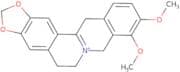
![Benzo[g]-1,3-benzodioxolo[5,6-a]quinolizinium, 5,6,8,13-tetrahydro-9,10-dimethoxy-](/_next/image/?url=https%3A%2Fstatic.cymitquimica.com%2Fcas-image%2Fthumb-webp%2F502775-benzo-g-13-benzodioxolo-56-a-quinolizinium-56813-tetrahydro-910-dimethoxy.webp&w=3840&q=75)
CAS 120834-89-1
:Benzo[g]-1,3-benzodioxolo[5,6-a]quinolizinium, 5,6,8,13-tetrahydro-9,10-dimethoxy-
Description:
Benzo[g]-1,3-benzodioxolo[5,6-a]quinolizinium, 5,6,8,13-tetrahydro-9,10-dimethoxy- is a complex organic compound characterized by its unique polycyclic structure, which includes a quinolizinium core fused with a benzodioxole moiety. This compound typically exhibits properties associated with heterocyclic compounds, such as potential fluorescence and photochemical activity. Its molecular structure suggests it may possess interesting electronic properties, making it a candidate for applications in organic electronics or as a dye. The presence of methoxy groups can influence its solubility and reactivity, potentially enhancing its stability and interaction with biological systems. Additionally, compounds of this nature may exhibit biological activity, which could be explored for pharmaceutical applications. However, specific characteristics such as melting point, solubility, and spectral data would require empirical investigation or reference to detailed chemical databases for precise information. Overall, this compound represents a fascinating area of study within organic and medicinal chemistry.
Formula:C20H20NO4
InChI:InChI=1S/C20H20NO4/c1-22-17-4-3-12-7-16-14-9-19-18(24-11-25-19)8-13(14)5-6-21(16)10-15(12)20(17)23-2/h3-4,8-9H,5-7,10-11H2,1-2H3/q+1
InChI key:InChIKey=NYDNLJQSIGOATO-UHFFFAOYSA-N
SMILES:O(C)C1=C2C[N+]3=C(C=4C(=CC5=C(C4)OCO5)CC3)CC2=CC=C1OC
Synonyms:- Benzo[g]-1,3-benzodioxolo[5,6-a]quinolizinium, 5,6,8,13-tetrahydro-9,10-dimethoxy-
- Lambertine
Sort by
Purity (%)
0
100
|
0
|
50
|
90
|
95
|
100
Found 1 products.
Dihydroberberine
CAS:Dihydroberberine is a berberine derivative, which is an alkaloid compound derived from various plants such as Berberis species. This product is known for its improved bioavailability compared to berberine itself. Dihydroberberine operates by modulating several cellular pathways, including the activation of AMP-activated protein kinase (AMPK), which plays a crucial role in energy homeostasis.Formula:C20H20NO4Purity:Min. 95%Molecular weight:338.4 g/mol