CAS 1210-12-4
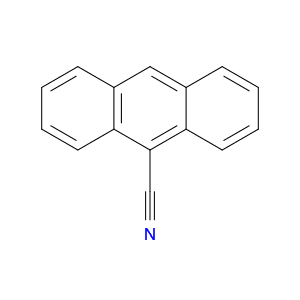
:9-Cyanoanthracene
Description:
9-Cyanoanthracene is an organic compound characterized by its anthracene backbone with a cyano group (-CN) attached at the 9-position. It appears as a solid, typically exhibiting a crystalline structure and is known for its deep blue fluorescence, making it useful in various applications, including organic electronics and as a fluorescent probe in chemical research. The compound has a relatively high melting point and is stable under standard conditions, although it can undergo photochemical reactions when exposed to light. 9-Cyanoanthracene is also notable for its ability to participate in electron transfer processes, which is valuable in the development of organic semiconductors and photovoltaic devices. Additionally, it is soluble in organic solvents, such as dichloromethane and acetone, but has limited solubility in water. Safety considerations should be taken into account, as it may pose health risks upon exposure, necessitating appropriate handling and storage measures in laboratory settings.
Formula:C15H9N
InChI:InChI=1S/C15H9N/c16-10-15-13-7-3-1-5-11(13)9-12-6-2-4-8-14(12)15/h1-9H
InChI key:InChIKey=KEQZHLAEKAVZLY-UHFFFAOYSA-N
SMILES:C(#N)C=1C2=C(C=C3C1C=CC=C3)C=CC=C2
Synonyms:- 9-Anthracenenitrile
- 9-Anthronitrile
- 9-Anthrracenecarbonitrile
- 9-Cyanoanthracene
- Anthracene-9-Carbonitrile
- Labotest-Bb Lt00159449
- NSC 26997
- 9-Anthracenecarbonitrile
Sort by
Purity (%)
0
100
|
0
|
50
|
90
|
95
|
100
Found 4 products.
Anthracene-9-carbonitrile
CAS:Anthracene-9-carbonitrileFormula:C15H9NPurity:98%Color and Shape: yellow-green solidMolecular weight:203.24g/mol9-Anthracenecarbonitrile
CAS:9-Anthracenecarbonitrile (9ACA) is a molecule that undergoes a phase transition from a solid to a liquid state at below -20°C. This phase transition can be monitored by changes in the vibrational, molecular, and kinetic properties. 9ACA is used for the synthesis of other compounds that have been found to have interesting photophysical and fluorescence properties. 9ACA reacts with carbon disulphide (CS2) to produce 2-cyano-1,3-dithiole-4,5(2H)-dione (CDD), which is then reacted with 3-chloroperoxybenzoic acid (CPBA). This reaction produces a number of products including 2-(trifluoromethyl)anthracene (TFA). It has been determined that the reaction proceeds through an initial step where TFA reacts with CS2 to produce the intermediate CS(TFA). The mechanism of this reaction is not yetFormula:C15H9NPurity:Min. 95 Area-%Color and Shape:PowderMolecular weight:203.24 g/mol