CAS 121250-06-4
:14-chlorodaunorubicin
Description:
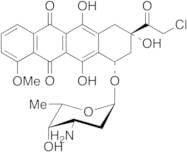
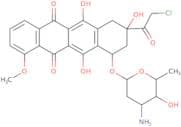
14-Chlorodaunorubicin is an anthracycline antibiotic and a derivative of daunorubicin, primarily used in cancer therapy. It exhibits potent antitumor activity by intercalating into DNA, thereby inhibiting topoisomerase II and disrupting DNA replication and transcription. This compound is characterized by its chlorinated structure, which enhances its cytotoxic properties compared to its parent compound. It is typically administered intravenously and is known for its effectiveness against various types of leukemia and solid tumors. However, like other anthracyclines, 14-chlorodaunorubicin is associated with significant side effects, including cardiotoxicity, myelosuppression, and potential for secondary malignancies. Its pharmacokinetics involve metabolism primarily in the liver, with excretion occurring through the bile. The compound's stability, solubility, and formulation are critical for its therapeutic efficacy and safety profile. Ongoing research continues to explore its potential in combination therapies and its mechanisms of resistance in cancer cells.
Formula:C27H28ClNO10
InChI:InChI=1/C27H28ClNO10/c1-10-22(31)13(29)6-17(38-10)39-15-8-27(36,16(30)9-28)7-12-19(15)26(35)21-20(24(12)33)23(32)11-4-3-5-14(37-2)18(11)25(21)34/h3-5,10,13,15,17,22,31,33,35-36H,6-9,29H2,1-2H3
SMILES:CC1C(C(CC(O1)OC1CC(Cc2c1c(c1c(C(=O)c3cccc(c3C1=O)OC)c2O)O)(C(=O)CCl)O)N)O
Synonyms:- 10-(4-amino-5-hydroxy-6-methyl-oxan-2-yl)oxy-8-(2-chloroacetyl)-6,8,11-trihydroxy-1-methoxy-9,10-dihydro-7H-tetracene-5,12-dione
- 3-(Chloroacetyl)-3,5,12-Trihydroxy-10-Methoxy-6,11-Dioxo-1,2,3,4,6,11-Hexahydrotetracen-1-Yl 3-Amino-2,3,6-Trideoxyhexopyranoside
Sort by
Purity (%)
0
100
|
0
|
50
|
90
|
95
|
100
Found 4 products.
14-Chloro Daunorubicin
CAS:Controlled ProductFormula:C27H28ClNO10Color and Shape:NeatMolecular weight:561.9614-Chloro daunorubicin
CAS:<p>14-Chloro daunorubicin is a chemotherapeutic agent, which is a synthetic derivative of the naturally occurring anthracycline antibiotic, daunorubicin. This compound is specifically modified to include a chlorine atom at the 14th position, which enhances its pharmacological effectiveness compared to its parent compound. The drug acts primarily by intercalating into DNA, disrupting the function of topoisomerase II, and generating free radicals. These mechanisms collectively inhibit DNA replication and transcription, leading to cell apoptosis, particularly in rapidly dividing cancer cells.</p>Formula:C27H28ClNO10Purity:Min. 95%Molecular weight:561.96 g/mol