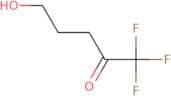
CAS 121749-66-4
:1,1,1-Trifluoro-5-hydroxy-2-pentanone
Description:
1,1,1-Trifluoro-5-hydroxy-2-pentanone is a fluorinated organic compound characterized by the presence of three fluorine atoms, a hydroxyl group, and a ketone functional group within its structure. This compound features a five-carbon chain, with the trifluoromethyl group located at the first carbon and the hydroxyl group at the fifth carbon. The presence of fluorine atoms imparts unique properties, such as increased lipophilicity and potential bioactivity, making it of interest in various fields, including pharmaceuticals and agrochemicals. The hydroxyl group contributes to its reactivity, allowing for hydrogen bonding and influencing its solubility in polar solvents. Additionally, the ketone functionality can participate in various chemical reactions, such as nucleophilic additions. The compound's stability and reactivity can be affected by the electronic effects of the trifluoromethyl group, which can also enhance its metabolic stability. Overall, 1,1,1-Trifluoro-5-hydroxy-2-pentanone is a versatile compound with potential applications in synthetic chemistry and material science.
Formula:C5H7F3O2
InChI:InChI=1S/C5H7F3O2/c6-5(7,8)4(10)2-1-3-9/h9H,1-3H2
InChI key:InChIKey=MQUFQHMYHVJCNY-UHFFFAOYSA-N
SMILES:C(C(F)(F)F)(CCCO)=O
Synonyms:- 2-Pentanone, 1,1,1-trifluoro-5-hydroxy-
- 1,1,1-Trifluoro-5-hydroxy-2-pentanone
Sort by
Purity (%)
0
100
|
0
|
50
|
90
|
95
|
100
Found 1 products.
1,1,1-Trifluoro-5-hydroxy-2-pentanone
CAS:1,1,1-Trifluoro-5-hydroxy-2-pentanone is a versatile building block that has been used extensively in the synthesis of complex compounds. It is an important reagent for the preparation of speciality chemicals and reactive intermediates. 1,1,1-Trifluoro-5-hydroxy-2-pentanone is also a useful intermediate for the synthesis of other compounds. This compound can be reacted with various groups to produce valuable scaffolds for drug discovery research.
Formula:C5H7F3O2Purity:Min. 95%Color and Shape:PowderMolecular weight:156.1 g/molRef: 3D-FT83611
Discontinued product