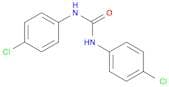
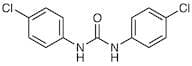
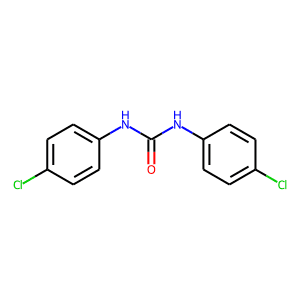
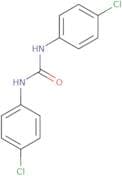
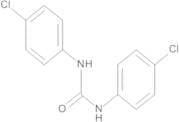
CAS 1219-99-4
:N,N'-bis(4-chlorophenyl)urea
Description:
N,N'-bis(4-chlorophenyl)urea, with the CAS number 1219-99-4, is an organic compound characterized by its urea functional group and two 4-chlorophenyl substituents. This substance typically appears as a white to off-white crystalline solid. It is known for its moderate solubility in organic solvents and limited solubility in water, which is common for many urea derivatives. The presence of chlorine atoms on the phenyl rings enhances its lipophilicity and may influence its biological activity. N,N'-bis(4-chlorophenyl)urea has been studied for its potential applications in various fields, including agriculture as a herbicide and in medicinal chemistry for its pharmacological properties. Its chemical structure allows for interactions with biological systems, making it a subject of interest in research related to drug development and environmental science. As with many chemical substances, handling should be done with care, following appropriate safety guidelines to mitigate any potential hazards associated with its use.
Formula:C13H10Cl2N2O
InChI:InChI=1/C13H10Cl2N2O/c14-9-1-5-11(6-2-9)16-13(18)17-12-7-3-10(15)4-8-12/h1-8H,(H2,16,17,18)
SMILES:c1cc(ccc1Cl)NC(=O)Nc1ccc(cc1)Cl
Synonyms:- Urea, N,N'-bis(4-chlorophenyl)-
- Ai3-23670
- Nsc 12979
- 1,3-Bis(4-Chlorophenyl)Urea
Sort by
Purity (%)
0
100
|
0
|
50
|
90
|
95
|
100
Found 10 products.
Triclocarban Related Compound A (1,3-Bis(4-chlorophenyl)urea)
CAS:Ureines and their derivatives; salts thereofFormula:C13H10Cl2N2OColor and Shape:White Off-White PowderMolecular weight:280.01702N,N'-BIS(P-CHLOROPHENYL)UREA
CAS:Formula:C13H10Cl2N2OPurity:97%Color and Shape:SolidMolecular weight:281.13731,3-Bis(4-chlorophenyl)urea
CAS:Formula:C13H10Cl2N2OPurity:>98.0%(HPLC)Color and Shape:White to Almost white powder to crystalMolecular weight:281.141,3-Bis(4-chlorophenyl)urea
CAS:1,3-Bis(4-chlorophenyl)ureaFormula:C13H10Cl2N2OPurity:99%Color and Shape:PowderMolecular weight:281.14g/mol1,3-Bis(4-chlorophenyl)urea
CAS:Triclocarban is a chlorinated aromatic compound that is widely used as a biocide in wastewater treatment. Triclocarban can be found in water, soil, and human and animal wastes. The analytical method for triclocarban is based on the reaction of the analyte with 1,3-bis(4-chlorophenyl)urea to form a red product that can be measured spectrophotometrically at 630 nm. Triclosan is another chlorinated aromatic compound that may contaminate water sources due to its use as an antimicrobial agent and deodorant. Triclosan has also been shown to have mutagenic properties. It has been shown to inhibit microbial growth by binding to nucleophilic sites on enzymes in the cell membrane or by forming stable complexes with metal ions necessary for cellular metabolism.Formula:C13H10Cl2N2OPurity:Min. 98 Area-%Color and Shape:White Off-White PowderMolecular weight:281.14 g/mol4,4′-Dichlorocarbanilide
CAS:Formula:C13H10Cl2N2OPurity:97%Color and Shape:SolidMolecular weight:281.144,4'-Dichlorocarbanilide
CAS:Controlled ProductApplications Triclocarban Related Compound A (cas# 1219-99-4) is a useful research chemical.
Formula:C13H10Cl2N2OColor and Shape:Off-WhiteMolecular weight:281.14