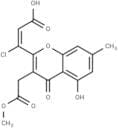
![4H-1-Benzopyran-3-aceticacid, 2-[(1E)-2-carboxy-1-chloroethenyl]-5-hydroxy-7-methyl-4-oxo-, a-meth…](/_next/image/?url=https%3A%2Fstatic.cymitquimica.com%2Fcas-image%2Fthumb-webp%2F314464-4h-1-benzopyran-3-aceticacid-2-1e-2-carboxy-1-chloroethenyl-5-hydroxy-7-methyl-4-oxo-a-methyl-ester-9ci.webp&w=3840&q=75)
CAS 121927-79-5
:4H-1-Benzopyran-3-aceticacid, 2-[(1E)-2-carboxy-1-chloroethenyl]-5-hydroxy-7-methyl-4-oxo-, a-methyl ester (9CI)
- 4H-1-Benzopyran-3-aceticacid, 2-(2-carboxy-1-chloroethenyl)-5-hydroxy-7-methyl-4-oxo-, a-methyl ester, (E)-
- Chloromonilinic acid B
Chloromonilinic acid B
CAS:Formula:C16H13ClO7Purity:78.44%Color and Shape:Brown. Oily solidMolecular weight:352.0Chloromonilinic acid B
CAS:Chloromonilinic acid B is a useful organic compound for research related to life sciences. The catalog number is T126197 and the CAS number is 121927-79-5.Formula:C16H13ClO7Color and Shape:SolidMolecular weight:352.72Chloromonilinic acid B
CAS:Chloromonilinic acid B is a secondary metabolite, which is derived from fungal sources, specifically produced by certain strains of Monilinia species. This compound exhibits its mode of action through interference with cellular processes in target organisms, disrupting membrane integrity and enzyme functions, ultimately leading to antifungal activity. Its utility spans across different research domains, particularly in studies involving plant-pathogen interactions and the mechanism of microbial resistance. Due to its bioactive properties, chloromonilinic acid B serves as a valuable tool for exploring the biochemical pathways involved in fungal infections. Additionally, its role in agricultural settings as part of integrated pest management strategies is being investigated due to its potential to mitigate crop loss by controlling fungal pathogens. Research continues into optimizing its production and application to explore its full potential in various scientific disciplines, highlighting its significance in advancing our understanding of fungal biochemistry and microbial ecology.
Formula:C16H13ClO7Purity:Min. 95%Molecular weight:352.72 g/molRef: 3D-WEA92779
Discontinued product