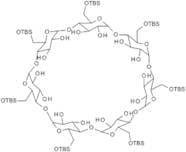
CAS 123155-03-3
:HEPTAKIS-6-(DIMETHYL-TERT-BUTYLSILYL)-BETA-CYCLODEXTRIN
Description:
Heptakis-6-(dimethyl-tert-butyldimethylsilyl)-beta-cyclodextrin is a modified cyclodextrin, which is a cyclic oligosaccharide composed of glucose units. This compound features a heptakis substitution at the 6-position of the beta-cyclodextrin, where a dimethyl-tert-butyldimethylsilyl group is attached. The modification enhances the solubility and stability of the cyclodextrin, making it useful in various applications, particularly in pharmaceuticals and analytical chemistry. Cyclodextrins are known for their ability to form inclusion complexes with a wide range of guest molecules, which can improve the bioavailability of poorly soluble drugs. The presence of the bulky silyl group can also influence the host-guest interactions, potentially allowing for selective binding of specific compounds. Additionally, this modification can provide protection against enzymatic degradation and improve the thermal stability of the cyclodextrin. Overall, heptakis-6-(dimethyl-tert-butyldimethylsilyl)-beta-cyclodextrin is a versatile compound with significant potential in drug delivery systems and other chemical applications.
Formula:C84H168O35Si7
Sort by
Purity (%)
0
100
|
0
|
50
|
90
|
95
|
100
Found 1 products.
6-Tert-butyldimethylsilyl-b-cyclodextrin
CAS:This beta-cyclodextrin (β-CD) derivative is a functionalized cyclic oligosaccharide composed of seven glucose units, characterized by a hydrophilic exterior and a lipophilic cavity (bigger than α-CD and smaller than γ-CDs), which allows it to encapsulate various guest molecules. This structural feature facilitates its use in multiple applications, including pharmaceuticals, food enhancement, and cosmetics. In the pharmaceutical industry, it enhances the solubility and stability of poorly water-soluble drugs, improving their bioavailability and efficacy while also masking unpleasant tastes. The food sector utilizes it as a stabilizer for flavors, colors, and nutrients, extending shelf life by protecting sensitive ingredients from degradation. In cosmetics, it serves as a complexing agent for fragrances and active components, ensuring their stability and controlled release. Its use expands to many other fields, including nanotechnology for drug delivery systems, environmental remediation for extracting organic pollutants, textiles for slow-release fragrances, and analytical chemistry for chiral separation.Formula:C84H168O35Si7Purity:Min. 95%Molecular weight:1,934.81 g/mol