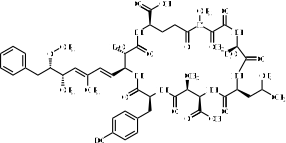
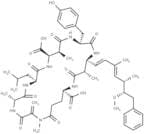
CAS 123304-10-9
:microcystin LY
Description:
Microcystin LY is a cyclic peptide toxin produced by certain species of cyanobacteria, particularly those in the genus Microcystis. It is known for its potent hepatotoxic effects, primarily targeting the liver and disrupting cellular processes. The structure of microcystin LY consists of a complex arrangement of amino acids, which contributes to its stability and toxicity. This compound is characterized by its ability to inhibit protein phosphatases, particularly PP1 and PP2A, leading to cellular dysregulation and potential cell death. Microcystin LY is soluble in water and has a relatively low volatility, making it a persistent contaminant in aquatic environments. Its presence in freshwater bodies can pose significant risks to human health and aquatic life, prompting concerns regarding water quality and safety. Monitoring and management of microcystin levels are crucial, especially in recreational waters and drinking water sources, to mitigate the risks associated with exposure to this harmful toxin.
Formula:C52H71N7O13
InChI:InChI=1/C52H71N7O13/c1-28(2)24-40-50(67)58-44(52(70)71)32(6)46(63)56-41(26-36-17-19-37(60)20-18-36)49(66)54-38(21-16-29(3)25-30(4)42(72-10)27-35-14-12-11-13-15-35)31(5)45(62)55-39(51(68)69)22-23-43(61)59(9)34(8)48(65)53-33(7)47(64)57-40/h11-21,25,28,30-33,38-42,44,60H,8,22-24,26-27H2,1-7,9-10H3,(H,53,65)(H,54,66)(H,55,62)(H,56,63)(H,57,64)(H,58,67)(H,68,69)(H,70,71)/b21-16-,29-25+
Synonyms:- Microcystin-LY solution
- Microcystin-LW solution
- 15-(4-hydroxybenzyl)-18-[(1Z,3E)-6-methoxy-3,5-dimethyl-7-phenylhepta-1,3-dien-1-yl]-1,5,12,19-tetramethyl-2-methylidene-8-(2-methylpropyl)-3,6,9,13,16,20,25-heptaoxo-1,4,7,10,14,17,21-heptaazacyclopentacosane-11,22-dicarboxylic acid
Sort by
The purity filter is not visible because current products do not have associated purity data for filtering.
Found 2 products.
Ref: 4Z-M-198004
Discontinued productMicrocystin-LY
CAS:Microcystin-LY, from Microcystis aeruginosa, is a heptapeptide toxin that triggers oxidative stress by activating the Nrf2 pathway, most effective at 3μM.
Formula:C52H71N7O13Color and Shape:SolidMolecular weight:1002.16