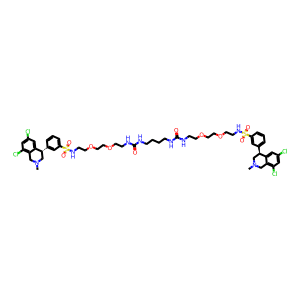
![17-[[[3-[(4S)-6,8-Dichloro-1,2,3,4-tetrahydro-2-methyl-4-isoquinolinyl]phenyl]sulfonyl]amino]-N-[2…](/_next/image/?url=https%3A%2Fstatic.cymitquimica.com%2Fcas-image%2Fthumb-webp%2F91265-17-3-4s-68-dichloro-1234-tetrahydro-2-methyl-4-isoquinolinyl-phenyl-sulfonyl-amino-n-2-2-2-3-4s-68-dichloro-1234-tetrahydro-2-methyl-4-isoquinolinyl-phenyl-sulfonyl-amino-ethoxy-ethoxy-ethyl-8-oxo-1215-dioxa-279-triazaheptadecanamide.webp&w=3840&q=75)
CAS 1234423-95-0
:17-[[[3-[(4S)-6,8-Dichloro-1,2,3,4-tetrahydro-2-methyl-4-isoquinolinyl]phenyl]sulfonyl]amino]-N-[2-[2-[2-[[[3-[(4S)-6,8-dichloro-1,2,3,4-tetrahydro-2-methyl-4-isoquinolinyl]phenyl]sulfonyl]amino]ethoxy]ethoxy]ethyl]-8-oxo-12,15-dioxa-2,7,9-triazaheptadecanamide
- 17-[[[3-[(4S)-6,8-Dichloro-1,2,3,4-tetrahydro-2-methyl-4-isoquinolinyl]phenyl]sulfonyl]amino]-N-[2-[2-[2-[[[3-[(4S)-6,8-dichloro-1,2,3,4-tetrahydro-2-methyl-4-isoquinolinyl]phenyl]sulfonyl]amino]ethoxy]ethoxy]ethyl]-8-oxo-12,15-dioxa-2,7,9-triazaheptadecanamide
- Ibsrela
- AZD 1722
- Tenapanor
- 12,15-Dioxa-2,7,9-triazaheptadecanamide, 17-[[[3-[(4S)-6,8-dichloro-1,2,3,4-tetrahydro-2-methyl-4-isoquinolinyl]phenyl]sulfonyl]amino]-N-[2-[2-[2-[[[3-[(4S)-6,8-dichloro-1,2,3,4-tetrahydro-2-methyl-4-isoquinolinyl]phenyl]sulfonyl]amino]ethoxy]ethoxy]ethyl]-8-oxo-
Tenapanor
CAS:Tenapanor (RDX 5791), an NHE3 inhibitor, regulates sodium in the gut and kidney with a strong preclinical safety record and minimal side effects.Formula:C50H66Cl4N8O10S2Purity:99.49% - 99.85%Color and Shape:SolidMolecular weight:1145.05Tenapanor (Butylene-D8)
CAS:Controlled ProductFormula:C50D8H58Cl4N8O10S2Color and Shape:NeatMolecular weight:1153.098Tenapanor
CAS:Controlled ProductFormula:C50H66Cl4N8O10S2Color and Shape:NeatMolecular weight:1145.049Tenapanor
CAS:Tenapanor is a novel antidiabetic drug that has been shown to be effective in the treatment of type 2 diabetes. Tenapanor (INN) reduces blood glucose levels by stimulating insulin release from pancreatic beta-cells and increasing insulin sensitivity in peripheral tissues. Tenapanor binds to the ATP-binding site of the phosphoinositide 3-kinase-related protein kinase 1 (PI3K1) enzyme, which is involved in glucose metabolism. It also inhibits phosphodiesterase 4D (PDE4D), an enzyme that degrades cyclic adenosine monophosphate (cAMP). This dual mechanism of action leads to increased insulin secretion and increased insulin sensitivity, which results in improved glycemic control.
Tenapanor has also been shown to improve long-term efficacy and reduce hypoglycemia when used as a pharmacological treatment for type 2 diabetes. The agent binds to ATP-binding sites on PI3K1, which prevents itsFormula:C50H66Cl4N8O10S2Purity:Min. 95%Molecular weight:1,145.04 g/mol