CAS 1239943-76-0
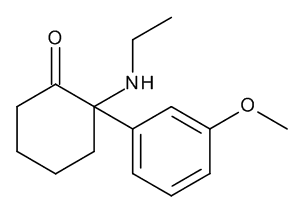
:Methoxetamine
Description:
Methoxetamine, often abbreviated as MXE, is a synthetic compound that belongs to the class of arylcyclohexylamines, which are known for their dissociative anesthetic properties. It is structurally related to ketamine and is characterized by the presence of a methoxy group attached to the aromatic ring. Methoxetamine acts primarily as an NMDA receptor antagonist, which contributes to its psychoactive effects, including dissociation, euphoria, and altered sensory perception. The substance has been reported to have a longer duration of action compared to ketamine, making it of interest in both recreational and research contexts. Methoxetamine is typically encountered in powder form and can be administered through various routes, including insufflation and oral ingestion. However, due to its potential for abuse and the lack of extensive clinical research, its safety profile and long-term effects remain inadequately understood. As a result, it is classified as a controlled substance in several jurisdictions, reflecting concerns regarding its use and potential for addiction.
Formula:C15H21NO2
InChI:InChI=1S/C15H21NO2/c1-3-16-15(10-5-4-9-14(15)17)12-7-6-8-13(11-12)18-2/h6-8,11,16H,3-5,9-10H2,1-2H3
InChI key:InChIKey=LPKTWLVEGBNOOX-UHFFFAOYSA-N
SMILES:N(CC)C1(C(=O)CCCC1)C2=CC(OC)=CC=C2
Synonyms:- 2-(Ethylamino)-2-(3-methoxyphenyl)cyclohexanone
- 2-(ethylaMino)-2-(3-Methoxyphenyl)-1-cyclohexanone
- Cyclohexanone, 2-(ethylamino)-2-(3-methoxyphenyl)-
- Methoxetamine
Sort by
The purity filter is not visible because current products do not have associated purity data for filtering.
Found 3 products.
Methoxetamine
CAS:Controlled ProductApplications Methoxetamine (MXE) or 3-MeO-2-Oxo-PCE is a chemical of the arylcyclohexylamine class. Methoxetamine is considered an analog of Ketamine (K165300) that also contains structural features of eticyclidine and 3-MeO-PCP, and is thought to be psychoactive. Methoxetamine is a product of rational drug design: its N-ethyl group was chosen to increase potency, lessening the risk of interstitial cystitis that can result from the accumulation of Ketamine-like metabolites in the urinary bladder.
References Ward, J. et al.: Clin. Toxicol., 49, 874 (2011); Wood, D.M. et al.: Eur. J. Clin. Pharmacol., 68, 853 (2012); Corazza, O. et al.: Hum. Psychopharmacol. Clin. Exp., 27, 145 (2012);Formula:C15H21NO2Color and Shape:NeatMolecular weight:247.33Methoxetamine (1 mg/ml in Methanol)
CAS:Controlled ProductFormula:C15H21NO2Color and Shape:Single SolutionMolecular weight:247.33Cyclohexanone, 2-(ethylamino)-2-(3-methoxyphenyl)-
CAS:Controlled ProductFormula:C15H21NO2Color and Shape:LiquidMolecular weight:247.3327