CAS 125607-05-8
:Benzenesulfonyl chloride, 2-chloro-4-fluoro-5-nitro-
Description:
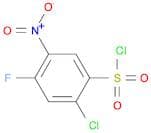
Benzenesulfonyl chloride, 2-chloro-4-fluoro-5-nitro- is an organic compound characterized by the presence of a benzenesulfonyl chloride group attached to a benzene ring that also features a chlorine atom, a fluorine atom, and a nitro group. This compound is typically a pale yellow to brown solid or liquid, depending on its form and purity. It is known for its reactivity, particularly due to the sulfonyl chloride functional group, which can participate in nucleophilic substitution reactions. The presence of the nitro group contributes to its electron-withdrawing properties, influencing its reactivity and making it useful in various synthetic applications, including the preparation of pharmaceuticals and agrochemicals. Additionally, the chlorine and fluorine substituents can enhance its biological activity and lipophilicity. Safety precautions are necessary when handling this compound, as it can be corrosive and may pose health risks if inhaled or in contact with skin. Proper storage and handling in a controlled environment are essential to mitigate these risks.
Formula:C6H2Cl2FNO4S
Sort by
Purity (%)
0
100
|
0
|
50
|
90
|
95
|
100
Found 3 products.
2-Chloro-4-fluoro-5-nitrobenzene-1-sulfonyl chloride
CAS:Formula:C6H2Cl2FNO4SMolecular weight:274.05382-Chloro-4-fluoro-5-nitrobenzenesulfonyl chloride
CAS:2-Chloro-4-fluoro-5-nitrobenzenesulfonyl chloridePurity:≥95%Molecular weight:274.05g/mol2-Chloro-4-fluoro-5-nitrobenzene-1-sulfonyl chloride
CAS:2-Chloro-4-fluoro-5-nitrobenzene-1-sulfonyl chloride is a synthetic, hydrolyzed nitroarene that is used as an intermediate for the synthesis of herbicides. It can be used to reduce carboxylic acids and carboxylic esters to produce alcohols and organic acids, respectively. 2C4FNS has been shown to react with iodides to form chloroiodide ions. Inorganic base reacts with 2C4FNS in the presence of water to form a redox cycle that produces chloride ions. Chloride ions can then react with carboxylic acids or carboxylic esters to form the corresponding acid chloride or ester chloride, respectively.Formula:C6H2Cl2FNO4SPurity:Min. 95%Molecular weight:274.05 g/mol