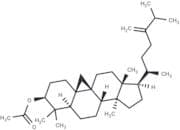
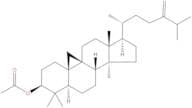
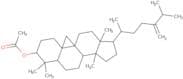
![1-(4-Isopropyl-1-methyl-4-pentenyl)-3a,6,6,12a-tetramethyltetradecahyd ro-1H-cyclopenta[a]cyclopro…](/_next/image/?url=https%3A%2Fstatic.cymitquimica.com%2Fcas-image%2Fthumb-webp%2F167202-1-4-isopropyl-1-methyl-4-pentenyl-3a-6612a-tetramethyltetradecahyd-ro-1h-cyclopenta-a-cyclopropa-e-phenanthren-7-yl-acetate.webp&w=3840&q=75)
CAS 1259-94-5
:1-(4-Isopropyl-1-methyl-4-pentenyl)-3a,6,6,12a-tetramethyltetradecahyd ro-1H-cyclopenta[a]cyclopropa[e]phenanthren-7-yl acetate
Description:
The chemical substance known as 1-(4-Isopropyl-1-methyl-4-pentenyl)-3a,6,6,12a-tetramethyltetradecahydro-1H-cyclopenta[a]cyclopropa[e]phenanthren-7-yl acetate, with the CAS number 1259-94-5, is a complex organic compound characterized by its intricate polycyclic structure. It features multiple fused rings, which contribute to its stability and unique chemical properties. The presence of isopropyl and methyl groups indicates a degree of branching that can influence its reactivity and interactions with other molecules. The acetate functional group suggests potential for esterification reactions and may affect its solubility in various solvents. This compound is likely to exhibit hydrophobic characteristics due to its large hydrocarbon framework, making it less soluble in polar solvents. Additionally, its structural complexity may impart interesting biological activities, although specific biological properties would require further investigation. Overall, this substance exemplifies the diversity of organic compounds and their potential applications in fields such as pharmaceuticals, materials science, and chemical synthesis.
- 24-Methylenecycloartanol acetate
Sort by
Purity (%)
0
100
|
0
|
50
|
90
|
95
|
100
Found 4 products.
9,19-Cyclolanostan-3-ol, 24-methylene-, 3-acetate, (3β)-
CAS:Formula:C33H54O2Purity:93.5%Molecular weight:482.780724-Methylenecycloartanol acetate
CAS:24-Methylenecycloartanol acetate has antiviral and antimicrobial activities.Formula:C33H54O2Purity:98%Color and Shape:SolidMolecular weight:482.79324-Methylenecycloartanol acetate
CAS:Formula:C33H54O2Purity:95%~99%Color and Shape:PowderMolecular weight:482.79324-Methylenecycloartanol acetate
CAS:24-Methylenecycloartanol acetate is a bioactive triterpenoid, which is typically derived from various plant sources. This compound is prevalent in plants such as ginseng and other medicinal herbs where it contributes to the plant's natural chemical defenses. Its mode of action involves modulating various biochemical pathways, particularly those related to lipid metabolism and cell signaling. It is known to potentially influence sterol biosynthesis pathways and interact with cell membranes, impacting cellular behavior.Formula:C33H54O2Purity:Min. 95%Molecular weight:482.8 g/mol