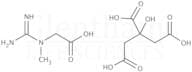
CAS 126-44-3
:Citrate(3-)
Description:
Citrate(3-) refers to the trivalent anion derived from citric acid, which is a key intermediate in the citric acid cycle, a crucial metabolic pathway in living organisms. The chemical structure of citrate(3-) features three carboxylate groups, which contribute to its acidic properties, and a hydroxyl group, making it a polyprotic acid. As a negatively charged ion, citrate(3-) plays significant roles in biochemistry, particularly in energy production and cellular metabolism. It acts as a chelating agent, binding metal ions and facilitating various biochemical reactions. Citrate is also commonly used in food and beverage industries as a flavoring agent and preservative, as well as in pharmaceuticals and cosmetics. The CAS number 126-44-3 specifically identifies the trisodium salt form of citrate, which is often utilized for its buffering capacity and solubility in aqueous solutions. Overall, citrate(3-) is an essential compound with diverse applications across multiple fields, including biochemistry, nutrition, and industrial processes.
Formula:C6H5O7
InChI:InChI=1S/C6H8O7/c7-3(8)1-6(13,5(11)12)2-4(9)10/h13H,1-2H2,(H,7,8)(H,9,10)(H,11,12)/p-3
InChI key:InChIKey=KRKNYBCHXYNGOX-UHFFFAOYSA-K
SMILES:C(CC([O-])=O)(CC([O-])=O)(C([O-])=O)O
Synonyms:- 1,2,3-Propanetricarboxylic acid, 2-hydroxy-, ion(3-)
- Citrate
- Citrate ion
- Citrate ion(3-)
- Citrate trianion
- Citrate(3-)
- Citric acid, ion(3-)
- Citricacid, ion(3-) (8CI)
Sort by
The purity filter is not visible because current products do not have associated purity data for filtering.
Found 1 products.