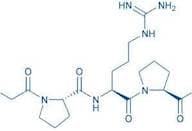
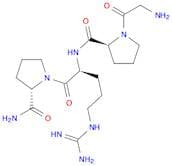
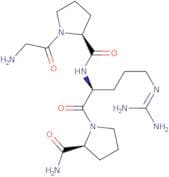
CAS 126047-75-4
:gly-pro-arg-pro amide acetate
Description:
Gly-Pro-Arg-Pro amide acetate, with the CAS number 126047-75-4, is a synthetic peptide that consists of a sequence of amino acids: glycine (Gly), proline (Pro), arginine (Arg), and another proline (Pro). This compound is characterized by its amide and acetate functional groups, which influence its solubility and stability. Peptides like Gly-Pro-Arg-Pro amide acetate are often studied for their biological activities, including potential roles in signaling pathways and their effects on cellular processes. The presence of proline in the sequence can impart unique conformational properties, potentially affecting the peptide's interaction with biological targets. Additionally, the acetate group may enhance solubility in aqueous environments, making it suitable for various biochemical applications. Overall, this compound is of interest in fields such as biochemistry, pharmacology, and medicinal chemistry, where understanding peptide interactions and functions is crucial for drug development and therapeutic applications.
Formula:C18H32N8O4
Synonyms:- H-Gly-Pro-Arg-Pro-NH2
Sort by
Purity (%)
0
100
|
0
|
50
|
90
|
95
|
100
Found 3 products.
H-Gly-Pro-Arg-Pro-NH₂
CAS:The inhibitory effect of GPRP amide on fibrinogen/thrombin clotting is 3.52 times higher than that of the corresponding tetrapeptide GPRP.Formula:C18H32N8O4Purity:97.2%Color and Shape:WhiteMolecular weight:424.5H-Gly-Pro-Arg-Pro-NH2 acetate salt
CAS:H-Gly-Pro-Arg-Pro-NH2 acetate salt is a peptide with antiplatelet activity. It has been shown to inhibit the interaction between fibrinogen and platelets, which leads to the inhibition of thrombin formation and subsequent clotting. The amide bond in this peptide is susceptible to hydrolysis by enzymes such as phospholipase A2, which means that it can be broken down into smaller fragments that have different biological activities. H-Gly-Pro-Arg-Pro-NH2 acetate salt has been shown to inhibit the growth of babesia microti, a causative agent of babesiosis in cattle, through lysis of infected erythrocytes. This drug also inhibits the growth of hemagglutinating virus type 3 (HV3) and filovirus, two viruses that are not yet fully understood.
Formula:C18H32N8O4Purity:Min. 95%Molecular weight:424.5 g/mol