


CAS 1265908-20-0
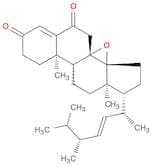
:(14β,22E)-8,14-Epoxyergosta-4,22-diene-3,6-dione
Description:
The chemical substance known as "(14β,22E)-8,14-Epoxyergosta-4,22-diene-3,6-dione" is a steroid derivative characterized by its unique structural features, including an epoxy group and a diene system. This compound belongs to the ergosterol family, which is significant in various biological processes, particularly in fungi and plants. The presence of the epoxy group indicates potential reactivity, making it a candidate for various chemical transformations. The diene functionality suggests that it may participate in conjugated reactions, which can be important in synthetic organic chemistry. Additionally, the presence of carbonyl groups (diones) in its structure may confer specific biological activities, including potential antimicrobial properties. The compound's stereochemistry, denoted by the (14β) and (22E) configurations, plays a crucial role in determining its biological interactions and pharmacological effects. Overall, this substance may have applications in medicinal chemistry and biochemistry, particularly in the study of fungal metabolites and their derivatives.
Formula:C28H40O3
InChI:InChI=1S/C28H40O3/c1-17(2)18(3)7-8-19(4)21-10-14-28-26(21,6)13-11-24-25(5)12-9-20(29)15-22(25)23(30)16-27(24,28)31-28/h7-8,15,17-19,21,24H,9-14,16H2,1-6H3/b8-7+/t18-,19+,21+,24+,25-,26+,27-,28+/m0/s1
InChI key:InChIKey=DJVSRKXHTYPLOV-ZNUAOLICSA-N
SMILES:C[C@@]12[C@@]3([C@@]4(O3)[C@@]([C@]5(C)C(C(=O)C4)=CC(=O)CC5)(CC1)[H])CC[C@@]2([C@@H](/C=C/[C@@H](C(C)C)C)C)[H]
Synonyms:- Ergosta-4,22-diene-3,6-dione, 8,14-epoxy-, (14β,22E)-
- (14β,22E)-8,14-Epoxyergosta-4,22-diene-3,6-dione
Sort by
Purity (%)
0
100
|
0
|
50
|
90
|
95
|
100
Found 2 products.
(1S,3R,6R,7R,10R,11R)-6-[(E,2R,5R)-5,6-Dimethylhept-3-en-2-yl]-7,11-dimethyl-2-oxapentacyclo[8.8.0.01,3.03,7.011,16]octadec-15-ene-1 4,17-dione
CAS:(E)-Parthenolide is a sesquiterpene lactone, which is a naturally occurring organic compound often extracted from plants such as feverfew (Tanacetum parthenium). This compound exerts its effects primarily through the modulation of NF-kB signaling pathways, which play crucial roles in the regulation of immune responses, cell proliferation, and survival. By inhibiting NF-kB, (E)-Parthenolide can interfere with the expression of genes that promote cell growth and inflammation. This action makes it a compound of interest in cancer research, particularly as a potential therapeutic agent that targets cancer stem cells and reduces chemoresistance. Its applications extend to studying its efficacy in inhibiting tumor growth and inducing apoptosis in various cancer cell lines. Moreover, due to its natural source, (E)-Parthenolide is also being explored for its potential as an anti-inflammatory agent in the treatment of inflammatory conditions.Formula:C28H40O3Purity:Min. 95%Molecular weight:424.6 g/mol

![(1S,3R,6R,7R,10R,11R)-6-[(E,2R,5R)-5,6-Dimethylhept-3-en-2-yl]-7,11-dimethyl-2-oxapentacyclo[8.8.0…](/_next/image/?url=https%3A%2Fstatic.cymitquimica.com%2Fproducts%2F3D%2Fthumb%2FQAC90820.jpg&w=3840&q=75)
