CAS 1267657-68-0
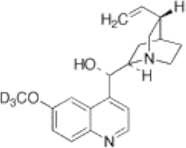
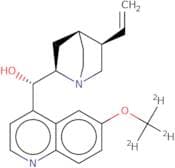
:[2H3]-Quinidine
- [2H3]-Quinidine
Quinidine-d3
CAS:Controlled ProductApplications A dextrorotatory stereoizomer of Quinine. Antiarrhythmic (class IA). Antimalarial.
Not a dangerous good if item is equal to or less than 1g/ml and there is less than 100g/ml in the package
References Loutfy, M.A., et al.: Anal. Profiles Drug Subs., 12, 483 (1983), Mason, J. W., et al.: Ann. N. Y. Acad. Sci., 432, 162 (1984),Formula:C202H3H21N2O2Color and Shape:Off-WhiteMolecular weight:327.44Quinidine-d3
CAS:Controlled ProductQuinidine-d3 is an extracellular form of the drug quinidine. It has been shown to be a p-gp substrate and increases the concentration–time curve of the drug lenalidomide. Quinidine-d3 is also used to measure the pharmacokinetics of drugs in animals, specifically in CD-1 mice. The molecule quinidine was first isolated from cinchona bark and was later synthesized in 1874 by Adolph Strecker. Quinine is a derivative of quinidine that is used as an anti-malarial drug. There are potential drug interactions with quinidine because it inhibits CYP2D6, CYP2C9, CYP3A4, and CYP2C19 enzymes.
Formula:C20H21D3N2O2Purity:Min. 95%Molecular weight:327.44 g/molRef: 3D-SAC65768
Discontinued product