CAS 12707-58-3
:Ganglioside GD1a
Description:
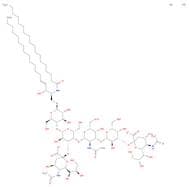
Ganglioside GD1a is a complex glycosphingolipid primarily found in the nervous system, particularly in the membranes of neurons. It is characterized by its structure, which includes a ceramide backbone linked to a carbohydrate moiety that contains sialic acid, specifically N-acetylneuraminic acid. This structure contributes to its role in cell signaling, cell recognition, and modulation of neuronal activity. GD1a is known to participate in various biological processes, including neurodevelopment and synaptic plasticity. It is also implicated in certain pathological conditions, such as neurodegenerative diseases. The presence of sialic acid in its structure gives GD1a a negative charge, influencing its interactions with other biomolecules. Additionally, gangliosides like GD1a are involved in the formation of lipid rafts, which are microdomains in cell membranes that play critical roles in signal transduction. Overall, GD1a is an important component of neuronal membranes, contributing to both structural integrity and functional dynamics within the nervous system.
Formula:Unspecified
InChI:InChI=1/C86H152N4O39.2Na/c1-6-8-10-12-14-16-18-20-22-24-26-28-30-32-34-36-51(100)50(90-60(105)37-35-33-31-29-27-25-23-21-19-17-15-13-11-9-7-2)46-118-80-69(111)67(109)72(57(43-94)120-80)123-82-71(113)78(129-86(84(116)117)39-53(102)62(88-48(4)98)77(128-86)65(107)55(104)41-92)74(59(45-96)122-82)124-79-63(89-49(5)99)75(66(108)56(42-93)119-79)125-81-70(112)68(110)73(58(44-95)121-81)126-85(83(114)115)38-52(101)61(87-47(3)97)76(127-85)64(106)54(103)40-91;;/h34,36,50-59,61-82,91-96,100-104,106-113H,6-33,35,37-46H2,1-5H3,(H,87,97)(H,88,98)(H,89,99)(H,90,105)(H,114,115)(H,116,117);;/q;2*+1/p-2/b36-34+;;/t50-,51+,52?,53?,54-,55-,56?,57?,58?,59?,61+,62+,63?,64-,65-,66?,67?,68?,69?,70?,71?,72?,73?,74?,75?,76?,77?,78?,79?,80?,81?,82?,85?,86?;;/m0../s1
SMILES:CCCCCCCCCCCCCCCC=CC(C(COC1C(C(C(C(CO)O1)OC1C(C(C(C(CO)O1)OC1C(C(C(C(CO)O1)O)OC1C(C(C(C(CO)O1)OC1(CC(C(C(C(C(CO)O)O)O1)N=C(C)O)O)C(=O)O)O)O)N=C(C)O)OC1(CC(C(C(C(C(CO)O)O)O1)N=C(C)O)O)C(=O)O)O)O)O)N=C(CCCCCCCCCCCCCCCCC)O)O.[Na].[Na]
Synonyms:- G<sub>D1a</sub>
- GD1a
- Ganglioside B1
- Ganglioside B<sub>1</sub>
- Ganglioside G3
- Ganglioside G<sub>3</sub>
- Ganglioside G<sub>D1a</sub>
- Ganglioside G<sub>II</sub>
- Ganglioside GD1a
- Ganglioside GII
- disialoganglioside-gd1A from bovine*brain
Sort by
Purity (%)
0
100
|
0
|
50
|
90
|
95
|
100
Found 6 products.
Ganglioside GD1a mixture (sodium salt)
CAS:Ganglioside GD1a, a glycosphingolipid in various organs, boosts tumor growth and vascular proliferation, and serves as a TLR2 coreceptor.Formula:C84H146N4O392NaColor and Shape:SolidMolecular weight:1836.1GD1a-Ganglioside
CAS:Formula:C84H146N4O39·2NaPurity:≥ 95%Color and Shape:White to yellow or light-tan powderMolecular weight:1882.10GD1a-Ganglioside sodium
CAS:GD1a (shown as sodium salt) is one of the major gangliosides in neuronal and glial membranes. It has a core tetrasaccharide structure (Galβ1,3GalNAcβ1,4Galβ1,4Glc) with sialic acids linked α2,3/α2,8 to the inner galactose residue, α2,3 to the outer galactose residue and ceramide linked β to position 1 on the reducing terminal glucose residue (Ledeen, 2009). It interacts with myelin-associated glycoprotein (MAG) and is essential for long-term axon-myelin stability. It plays a role in viral infection as it is a receptor for viral glycoproteins in rotavirus and paramyxovirus 1. The hexasaccharide GD1a moiety was also found on a glycoprotein that acts as a receptor for adenovirus type 37. GD1a ganglioside also interacts with botulinum neurotoxin and is crucial for its entry into cells (Kolter, 2012).Formula:C84H148N4O39·xNaPurity:Min. 95%Color and Shape:White PowderMolecular weight:1,838.08 g/molGD1a-Ganglioside
CAS:GD1a ganglioside is one of the major gangliosides in neuronal and glial membranes. It has a core tetrasaccharide structure (Galβ1,3GalNAcβ1,4Galβ1,4Glc) with sialic acids linked α2,3/α2,8 to the inner galactose residue, α2,3 to the outer galactose residue, and ceramide linked β to position 1 on the reducing terminal glucose residue (Ledeen, 2009). GD1a ganglioside interacts with myelin-associated glycoprotein (MAG) and is essential for long-term axon-myelin stability. GD1a ganglioside plays a role in viral infection as it is a receptor for viral glycoproteins in rotavirus and paramyxovirus 1. The hexasaccharide GD1a moiety was also found on a glycoprotein that acts as a receptor for adenovirus type 37. GD1a ganglioside also interacts with botulinum neurotoxin (BoNT) and is crucial for its entry into cells (Kolter, 2012). The functional significance of ammonia in the brain is not fully understood see: (Modi, 1994).Formula:C84H148N4O39Purity:Min. 95%Color and Shape:PowderMolecular weight:1,838.08 g/mol