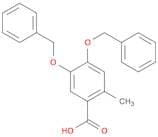
CAS 127531-39-9
:2-methyl-4,5-bis(phenylmethoxy)-benzoic acid
Description:
2-Methyl-4,5-bis(phenylmethoxy)-benzoic acid, with the CAS number 127531-39-9, is an organic compound characterized by its complex structure featuring a benzoic acid core substituted with two phenylmethoxy groups and a methyl group. This compound typically exhibits properties associated with aromatic compounds, such as stability and relatively high melting and boiling points. The presence of the carboxylic acid functional group (-COOH) contributes to its acidity and potential for hydrogen bonding, influencing its solubility in polar solvents. The phenylmethoxy substituents enhance its lipophilicity, which may affect its biological activity and interactions with other molecules. Additionally, this compound may exhibit interesting photophysical properties, making it of interest in fields such as materials science and pharmaceuticals. Its synthesis and applications could be relevant in organic synthesis and medicinal chemistry, particularly in the development of new therapeutic agents or functional materials. As with any chemical, safety data and handling precautions should be observed due to potential hazards associated with its use.
Formula:C22H20O4
InChI:InChI=1S/C22H20O4/c1-16-12-20(25-14-17-8-4-2-5-9-17)21(13-19(16)22(23)24)26-15-18-10-6-3-7-11-18/h2-13H,14-15H2,1H3,(H,23,24)
SMILES:Cc1cc(c(cc1C(=O)O)OCc1ccccc1)OCc1ccccc1
Synonyms:- Benzoic Acid, 2-Methyl-4,5-Bis(Phenylmethoxy)-
- 4,5-Bis(benzyloxy)-2-methylbenzoic acid
Sort by
Purity (%)
0
100
|
0
|
50
|
90
|
95
|
100
Found 3 products.
4,5-Dibenzyloxy-2-methylbenzoic acid
CAS:4,5-Dibenzyloxy-2-methylbenzoic acidPurity:≥95%Molecular weight:348.39g/mol4,5-Dibenzyloxy-2-methylbenzoic acid
CAS:4,5-Dibenzyloxy-2-methylbenzoic acid (DBMA) is a chemical compound that is known to be an inhibitor of the growth factor receptor. It has been shown to inhibit the growth factor receptor in a dose-dependent manner. DBMA binds to the cytoplasm and inhibits protein synthesis by binding to sequences that are involved in regulating gene expression. This compound also interacts with other proteins including those involved in DNA replication, transcription, and translation. DBMA has been shown to interact with the protein polymerase chain and has been found to bind to the bacterial cells of Salmonella typhimurium.
Formula:C22H20O4Purity:Min. 95%Molecular weight:348.39 g/mol